Category: Strategy

  • Organic Growth Strategy: What to Do When Paid Ads Plateau

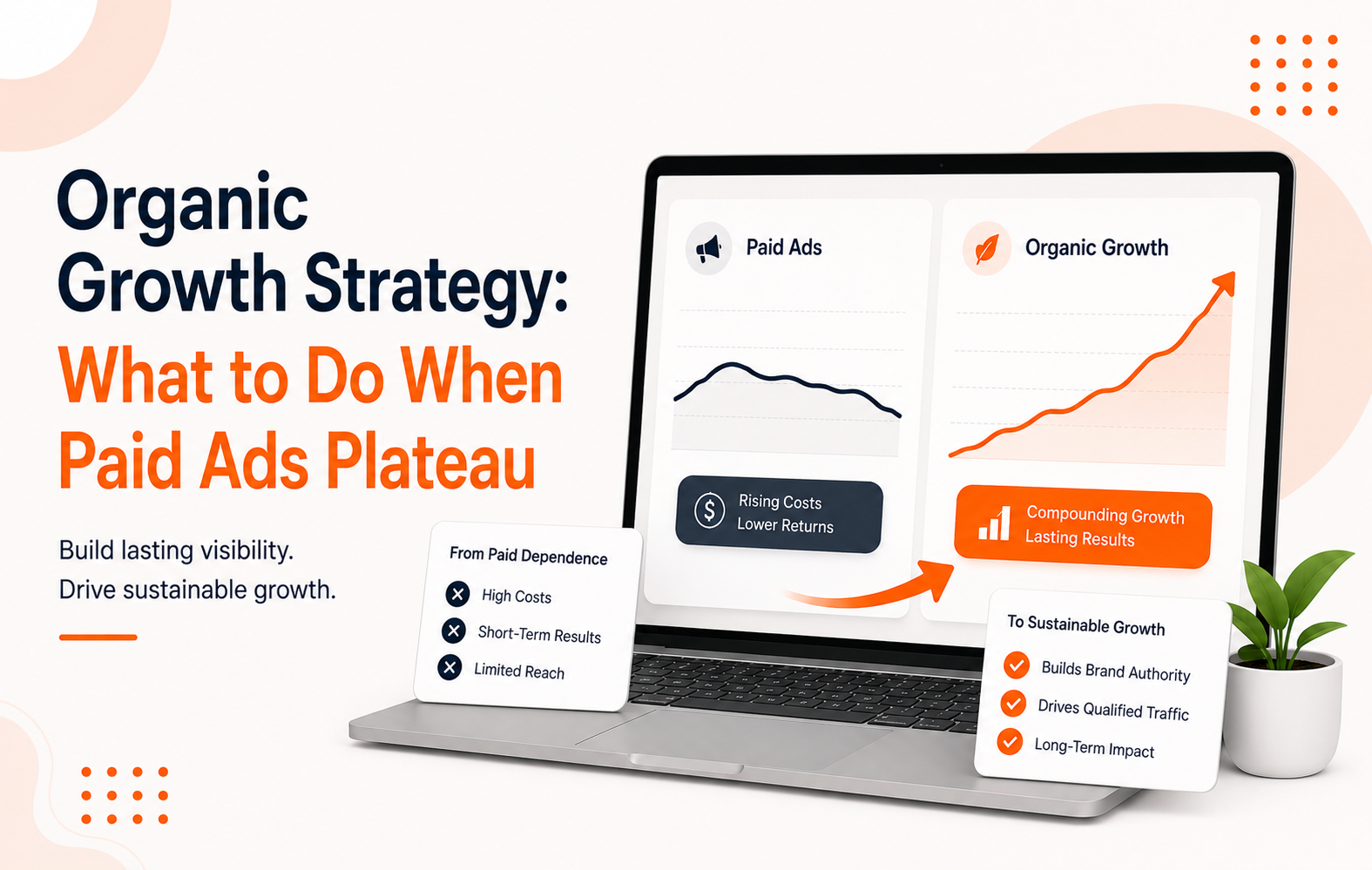
    Organic Growth Strategy: What to Do When Paid Ads Plateau

    Paid ads are great until the math stops getting prettier. CAC creeps up, ROAS gets tighter, and each new dollar starts working harder for less.

    That does not mean your brand is broken. For many high growth firms, it simply means the next stage of sustainable growth requires assets that continue creating visibility, trust, and demand beyond paid media.

    Making this shift often requires a change in company culture. Strong digital marketing systems are built around serving a specific target audience consistently, not just chasing short-term campaign performance.

    Key Takeaways

    If your paid program has flattened out, here is the short version:

    • Paid ads capture existing demand, but they do not always create enough new demand on their own.
    • Organic growth compounds through content, search visibility, AI answers, video discovery, and branded demand.
    • Modern digital marketing visibility extends beyond Google rankings to platforms like ChatGPT, Perplexity, Google AI Overviews, and YouTube.
    • Strong organic systems are built through structure, consistency, and a deep understanding of your target audience.
    • Sustainable growth comes from building assets, not just buying attention.

    Keep that frame in mind as you read. You are not replacing one channel with another. You are building an asset.

    Why Paid Ads Plateau

    Paid media usually does not fail all at once. It gets more expensive and less forgiving. Then one day you realize the team is working twice as hard to squeeze out the same result.

    A lot of brands do not have a product problem at this stage. They have a discoverability problem. The people who are ready to buy right now might already know you, have clicked before, or have seen the same creative too many times.

    So your campaigns start circling the same pool.

    That pattern lines up with recent thinking on the growth plateau and brand awareness. Once performance channels saturate existing demand, more spend often delivers smaller gains.

    You are still capturing demand, but you are not creating enough of it. Unlike inorganic growth, which often relies on external injections like mergers and acquisitions or heavy ad spend to inflate numbers, organic methods utilize existing resources and internal resources to build value from within.

    Paid media rents attention. Organic visibility builds an asset.
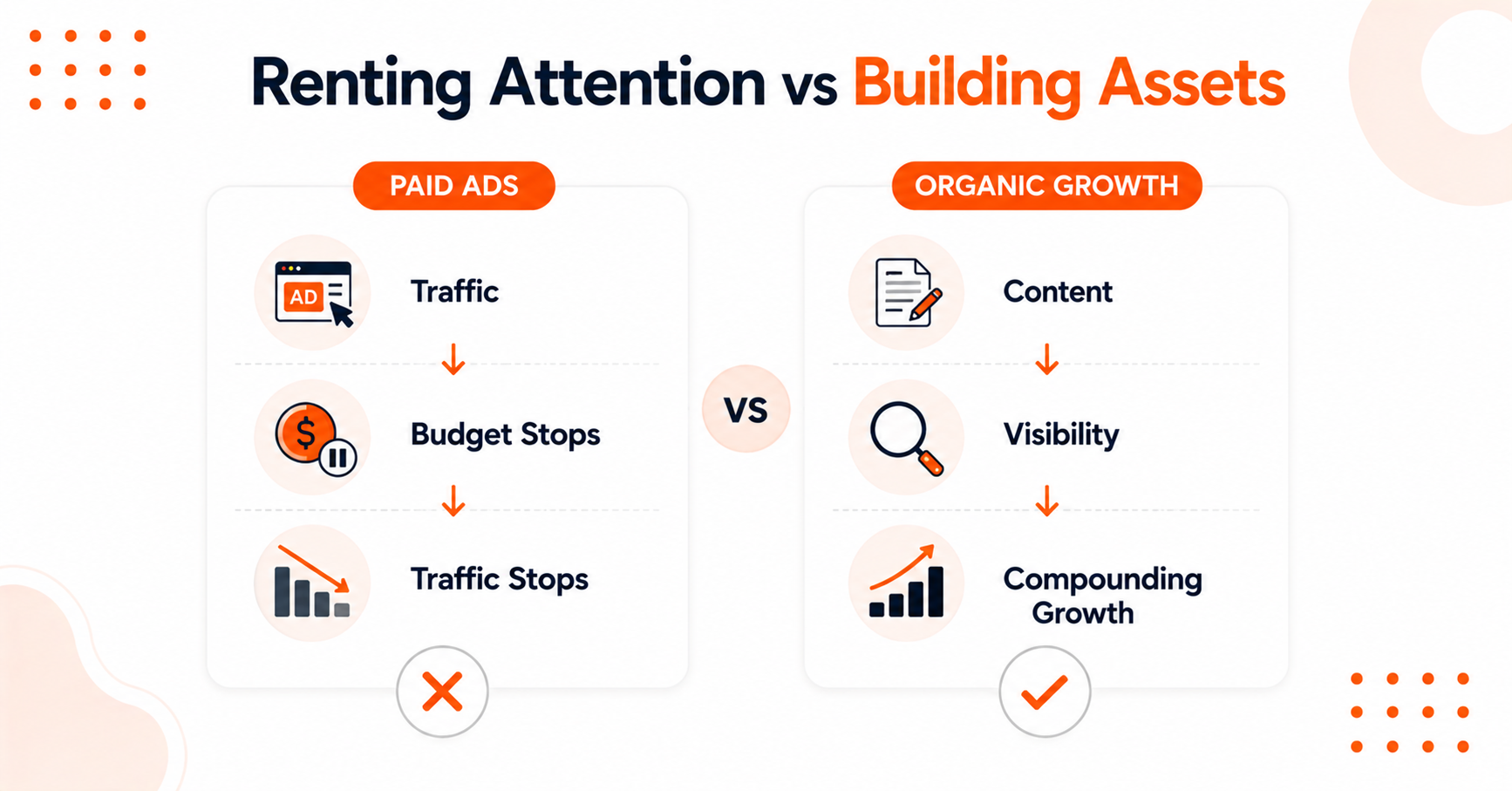
    Renting attention and building assets organically comparison.

    That is the big distinction. Paid is a faucet. Turn it on, traffic flows. Turn it off, it stops.

    Organic is slower at the start, but each page, video, answer, and mention keeps working after it is published. Over time, that stack of assets starts doing real work for you.

    This is also why going all-in on paid after a plateau often backfires. You do not need more pressure on the same channel. You need more surfaces where buyers can find you, trust you, and come back on their own.

    Moving From Capturing Demand to Creating It

    Here is the shift: stop asking only, "How do we buy more clicks?" Start asking, "How do we become the brand people find before they are ready to click an ad?"

    That is how growth opens back up.

    People do not only search the old way anymore. They ask full questions in ChatGPT. They compare options in Perplexity.

    They scan Google's AI Overviews before they ever touch a blue link. If your brand is not part of those answers, you disappear early, before the buying conversation even starts.

    So what creates demand? It starts with thorough market research to identify exactly what your audience is asking.

    Once you have those insights, you can:

    • Build useful content
    • Create strong category and product pages
    • Publish comparison guides that speak directly to a niche market
    • Highlight your unique differentiators through video demos, tutorials, and buyer education

    This helps build an audience that remembers you when the problem shows up next month, not only today.

    A simple look at organic growth vs paid ads makes the same point clearly: paid gets distribution fast, while organic builds trust and discoverability that last longer.

    For mature SaaS, DTC, and ecommerce brands, that is even more important because the easy paid wins are usually gone already.

    The good news is that demand creation is not vague brand fluff. It is operational.

    You publish content around real questions uncovered in your research. You build pages around specific use cases. You show up for comparisons, setup problems, pricing questions, and category terms.

    Then you keep improving what starts to rank, what gets cited, and what assists conversions.

    Now you are not waiting for the next paid optimization trick. You are expanding how the market finds you.

    Building a Self-Sustaining Organic Growth Strategy
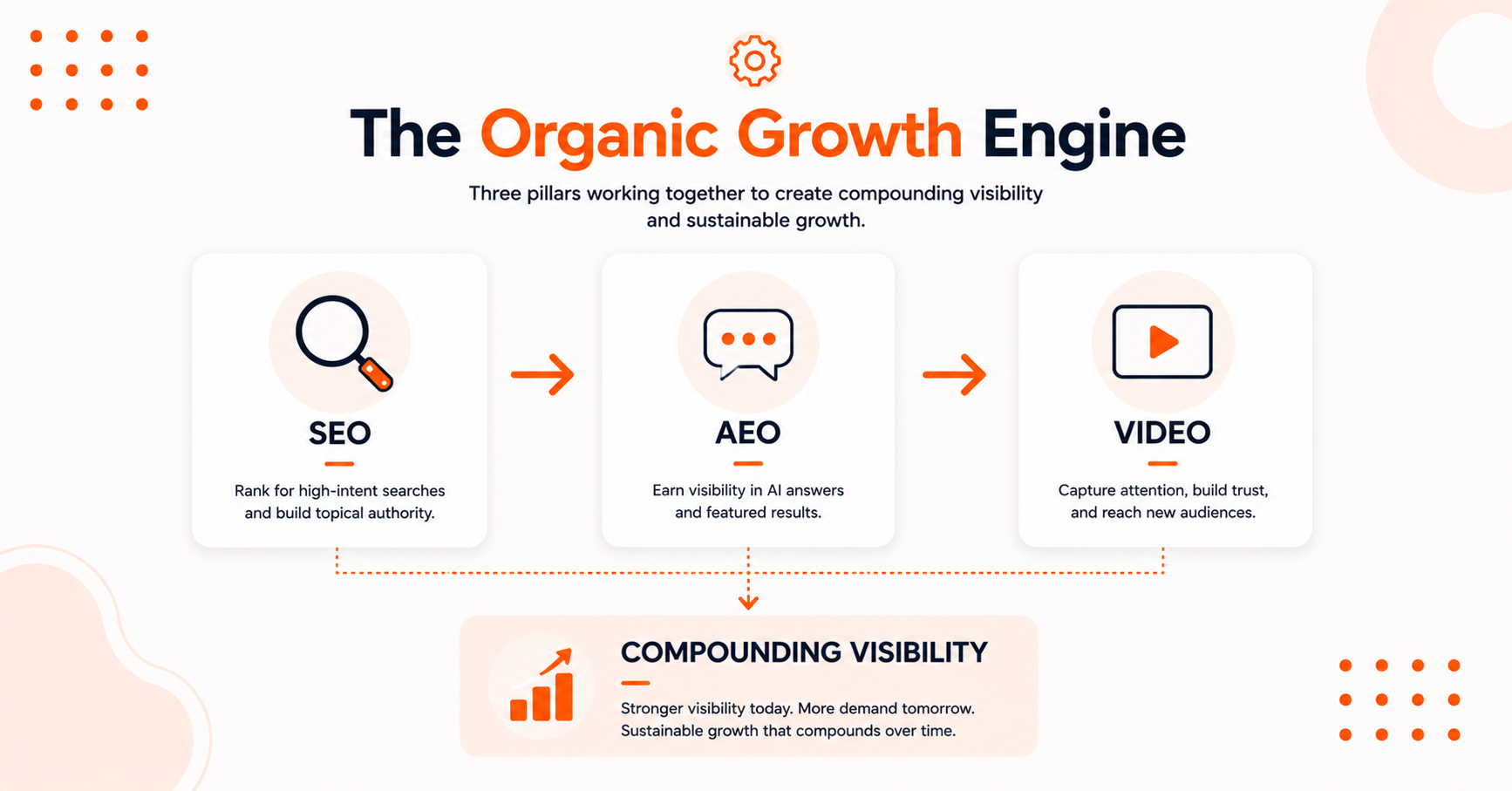
    Organic growth engine framework.

    The strongest post-plateau strategy usually has three working parts:

    • Search
    • Answer visibility
    • Video

    Not one or the other. All three, tied together.

    Buyers rarely move in a straight line anymore. They search, watch, compare, ask AI, come back, and search again.

    Modern SEO Still Does the Heavy Lifting

    SEO still matters. A lot. But modern SEO is not about publishing random blog posts and hoping a keyword sticks.

    It starts with structure. Clean technical foundations. Clear site architecture.

    Topic clusters that show depth. Internal links that connect related pages. Refreshes for older content that is slipping.

    Pages that answer a question fast, then prove the answer with detail. When you refine these elements, your site gains a distinct competitive advantage in the search results.

    This is also where semantic SEO and entity clarity start pulling their weight. Search engines do not only match keywords now. They try to understand what your brand, products, and pages actually are.

    If your naming is messy, your pages are disconnected, or your product language changes every five minutes, you make that job harder.

    Schema helps. FAQ markup still helps.

    So do clean headings, short definitions, comparison tables, and direct answers near the top of the page. For many question-led searches, a tight 40 to 60 word answer under a clear heading gives Google and AI systems something easy to lift.

    If you want to see how those pieces fit together in practice, Refresh's organic growth and SEO services lay out the mix of SEO, AEO, and video that drives compounding visibility.

    AEO Puts Your Brand in the Answer

    Answer engine optimization, or AEO, is the next layer. Search is turning into an answer layer. That is the real change.

    If your brand is not part of the answer, you are invisible earlier in the journey.

    AEO means building pages and brand signals that machines can trust and extract. That includes direct question-and-answer formatting, strong entity signals, consistent company and product descriptions, trusted mentions across the web, and content that matches the language buyers use when they ask full questions.

    This is also why featured snippets, AI Overviews, and answer engines overlap so much. Clear structure helps all of them.

    So does authority. So does saying one thing plainly instead of burying the answer halfway down the page.

    Video Creates Discovery and Trust

    YouTube is still the second-largest search engine, and most brands still treat it like a side project. That is a miss.

    Video is where trust gets built fast. A good demo, tutorial, teardown, or comparison can rank, get shared, and assist conversions long after publish day.

    It also gives you assets to reuse across email, product pages, social clips, and sales follow-up. For brands in professional services or a specific niche market, video content is an essential way to humanize your expertise.

    Furthermore, the comments and engagement on these videos often act as an informal product development feedback loop, helping you understand what your audience actually wants to see next.

    The best brand videos do not open with a logo animation and a slow intro. They open with the problem, the audience, and the payoff.

    Then they show the product. Fast.

    For software brands, that might be a setup guide or workflow tutorial. For DTC and ecommerce, it might be a product comparison, use-case demo, or "why choose this over that" explainer.

    Either way, the rule is the same: lead with the buyer's question, not your internal feature launch.

    How to Reallocate Budget Without Breaking Pipeline

    Don't panic and cut your paid budget. That is the wrong move for most brands.

    Keep the campaigns that still produce. Brand search, high-intent retargeting, top-performing acquisition pockets, and launch support often deserve to stay.

    Cut the campaigns you keep defending only out of habit.

    A hybrid model usually wins here. Paid keeps short-term demand moving, while organic builds the system that lowers your dependence on inorganic growth over time.

    This basic hybrid strategy tends to outperform all-or-nothing channel bets by creating a sustainable foundation for long-term revenue generation. This approach is particularly effective for professional services firms looking to stabilize their pipeline as they transition away from ad-dependent tactics.

    A phased approach keeps the transition practical while supporting overall business expansion:

    TimeframeKeep Paid Focused OnBuild OrganicallyFirst 90 DaysBrand search, retargeting, proven campaignsTechnical fixes, content map, conversion pagesMonths 3 to 6Efficient acquisition pocketsTopic clusters, FAQ pages, comparison pages, YouTube libraryMonths 6 to 12Launch support and remarketingContent refreshes, AI answer visibility, branded demand

    The mistake is funding organic with leftovers. If it only gets the scraps, it never gets enough momentum to matter.

    Give it real resources, real ownership, and a clear scorecard.

    And if your in-house team is already stretched, that is usually the moment to think seriously about how to scale with an organic growth agency.

    Not because an agency is magic, but because compounding channels require consistent, expert execution.

    What to Measure in the First 12 Months

    If you only track traffic, you will either get false confidence or false panic.

    A better scorecard has leading indicators and business outcomes side by side.

    Early on, look for non-brand impressions, ranking movement on target pages, snippet wins, stronger branded search, watch time, and pages getting indexed and cited.

    Those numbers tell you the machine is starting to turn. Then, tie that to outcomes that matter. Track demo requests, trial starts, and email signups.

    Pay attention to revenue assisted by organic sessions, product page conversions from non-brand traffic, and video views that lead to site visits.

    Beyond acquisition, include metrics related to existing clients to understand how your organic content supports customer retention. Evaluating the overall customer experience helps ensure your strategy is nurturing existing customers as well as attracting new ones.

    For AI and answer visibility, measurement is still a little messy. That is fine.

    Use a fixed set of prompts. Check whether your brand appears. Track referrals when they show up. Watch which pages get pulled into search features and protect those pages once they win.

    One more thing: refreshes matter. If a page climbs to page one or wins a snippet, do not leave it alone for a year.

    Update it. Strengthen internal links. Expand supporting content around it. Organic gains stick better when you defend them.

    The point is not to collect pretty dashboards. The point is to see whether your organic system is reducing paid dependency while growing pipeline.

    The Mistakes That Keep Brands Stuck

    The first mistake is expecting paid-speed results from organic work. That is how teams quit too early. Organic growth usually starts showing real traction in months, then compounds after the content base, links, and internal structure begin reinforcing each other.

    This transition requires a company culture that values long-term compounding over immediate gratification, as impatience often kills potential success before it has a chance to flourish.

    The second mistake is publishing disconnected content. More posts do not equal more growth. If the site feels like a pile of one-off ideas, search engines and buyers both have to guess what you do best.

    Furthermore, even if your content strategy attracts high-quality traffic, failing to provide excellent customer service can undermine the trust you worked so hard to build, causing potential leads to look elsewhere.

    The third mistake is boxing SEO, AEO, and video into separate silos. They work better together. A strong article can power an AI answer, feed a sales page, become a video script, and earn internal links from related pages.

    The fourth mistake is obsessing over rankings without asking whether the right people are finding the right page. Ranking for a broad query that never converts is not a win. It is noise.

    Most brands do not need more content. They need a tighter system.

    FAQs About Organic Growth Strategy

    Below are the related questions you might ask, too.

    How Long Does an Organic Growth Strategy Take to Work?

    Most brands start seeing early traction in 3 to 6 months if the work is focused and consistent. While inorganic growth through paid media provides an immediate spike in traffic, organic results are slower to materialize but offer much better long-term stability.

    The bigger payoff usually shows up after that, once topic clusters, internal links, refreshed content, and video assets start reinforcing each other. Some pages move fast, but the real win is the compounding effect.

    Should We Cut Paid Ads Once Organic Starts Working?

    No, you usually should not cut paid ads once organic starts working. Paid still has a strong job to do, especially for launches, remarketing, branded demand capture, and proven acquisition pockets.

    The goal is not to replace paid with organic. The goal is to stop being over-dependent on paid for every lead, every visit, and every month of growth.

    What Content Should We Publish First After a Paid Plateau?

    Start with bottom-of-funnel and high-intent content. That means product comparisons, category pages, use-case pages, pricing questions, setup guides, buyer FAQs, and video demos.

    Go where purchase intent already exists. This approach is equally valuable for existing clients, as helpful content can deepen their trust and eventually increase your share of wallet.

    Once you have those foundations, build out the mid-funnel education that creates more demand around those money pages.

    Does AI Search Change the Strategy?

    Yes, AI search changes the strategy, but it does not replace the basics. Clear structure, strong brand signals, direct answers, entity clarity, and trusted mentions matter even more now.

    If someone asks ChatGPT or sees a Google AI Overview, your brand needs to be easy to understand and easy to cite. Good SEO now supports answer visibility too.

    Can an In-House Team Do This Without Outside Help?

    Yes, an in-house team can do this without outside help if strategy, content, technical SEO, web, and distribution are all aligned. That is the hard part.

    Many teams have the talent but not the bandwidth or ownership model to execute consistently. Success often depends on whether the team leverages external advisory services to provide expert guidance and ensures that their content strategy is fully integrated with their customer service department.

    When these areas are aligned, an outside perspective keeps the engine moving instead of letting every initiative stall in planning.

    Ready to Grow Beyond the Limits of Paid Media?

    When paid ads flatten out, the answer usually is not to buy harder. Instead, it is to build an engine that continues to perform even when your media spend stops.

    An effective organic growth strategy delivers more than temporary spikes in traffic. It creates stronger discovery, deeper audience trust, and a consistent stream of branded demand that compounds over time.

    That is what sustainable growth looks like after the plateau. By investing in SEO, AEO, and video content, brands can reduce their dependence on paid media while continuing to expand their visibility and authority.

    At Refresh, we help businesses strengthen their organic presence through content, search, and answer-driven strategies built for long-term growth. If you are ready to build a more sustainable growth engine, book a call now!
  • Multi-Location SEO Strategy for Service Brands

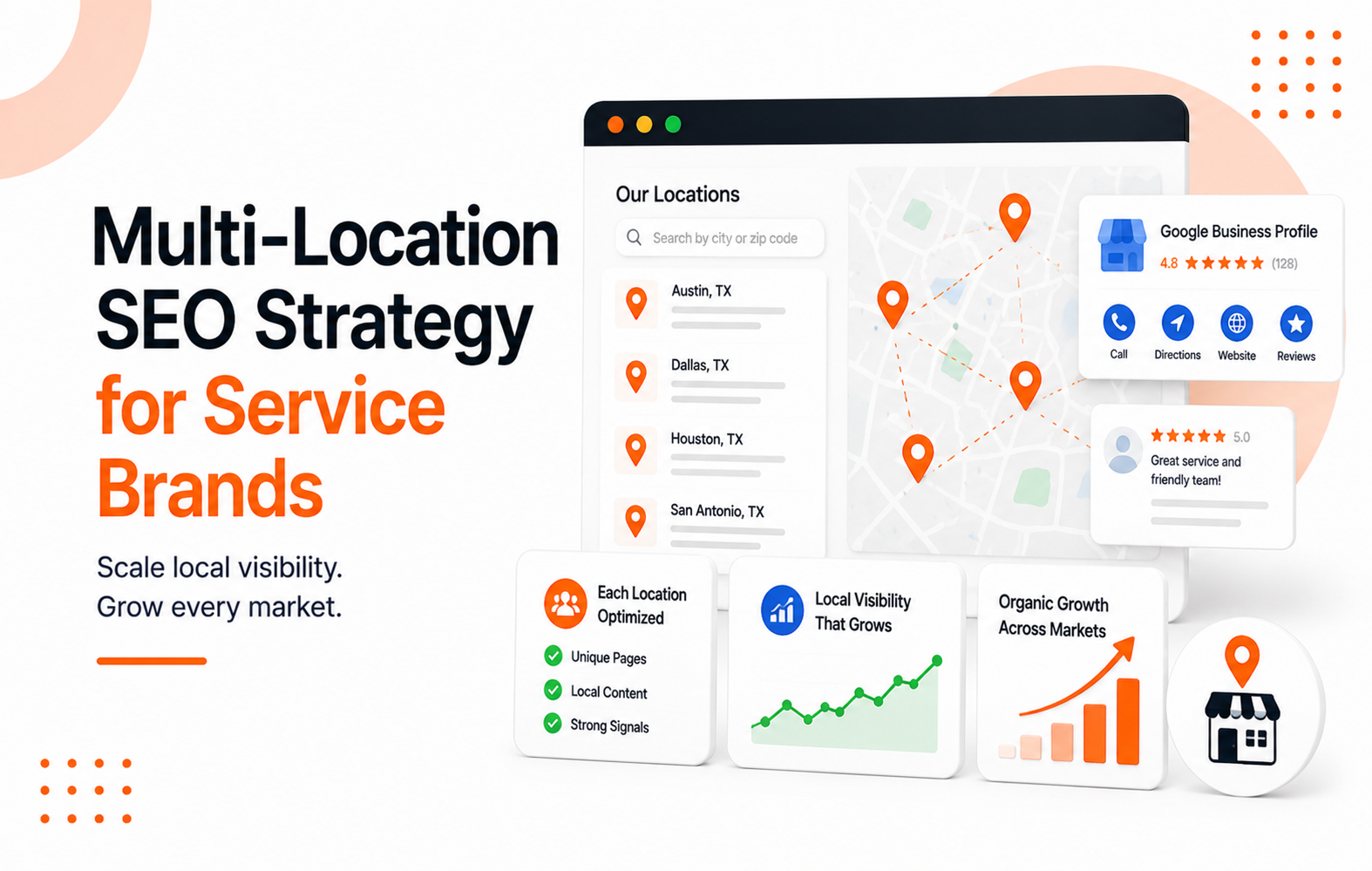
    Multi-Location SEO Strategy for Service Brands

    Managing fifty locations is a significant achievement in scale. However, without a cohesive approach, those locations can struggle to earn visibility in local search results, and in some cases, end up competing against each other for the same customers.

    That is why a strong multi-location SEO strategy is not simply about publishing more pages. It is about creating a scalable system that search engines can understand, local teams can maintain, and customers can trust.

    When done well, multi-location SEO helps every branch strengthen the brand's overall visibility while capturing demand in its local market. The result is sustainable organic growth that compounds over time instead of resetting every month like paid traffic.

    Key Takeaways

    • Build one clean structure for the entire brand, then optimize for local intent within that framework.
    • Give every physical branch its own dedicated location page and a unique Google Business Profile to capture regional traffic.
    • Use templates for efficiency, but fill them with unique content, local relevance, and genuine proof points.
    • Maintain strict NAP consistency for your name, address, and phone number across your website, social profiles, and third-party directories.
    • Measure success through leads, calls, and booked jobs by market rather than rankings alone.

    Build One System for 50+ Locations

    Once a service brand crosses 50 locations, random local marketing stops working. You need rules, ownership, and one source of truth.

    The mess usually shows up in three places. Site structure becomes sloppy, profiles are half-managed, and different teams publish different phone numbers, hours, and service details.

    Six months later, Google is confused because the lack of brand consistency makes it difficult to trust your data.

    Create a Scalable Site Structure

    Start with a solid website structure. Build a main locations hub using subfolders instead of subdomains to maximize your domain authority.

    From there, create a searchable directory and one page per physical location. Then, add service-plus-location pages only when there is real search demand and real local context.

    Do not crank out every service in every city just because the CMS makes it easy. That is how large brands bloat themselves into thin, repetitive pages.

    For brands with years of old pages, broken redirects, and overlapping locations, scaling local SEO efforts usually starts with cleanup, not expansion.

    Strengthen Internal Linking

    Internal linking matters here too. Location pages should connect to core services, financing or booking pages, and nearby branches where it helps the user.

    By strategically mapping these connections, you improve crawlability across your entire directory. Keeping high-value pages within a few clicks of your homepage helps search engines index your content efficiently while helping users navigate your site without friction.

    Scale the system, localize the proof.

    That is the job.

    Create Location Pages That Earn Trust

    This is where many large rollouts fall apart. The brand uses a generic template, swaps the city name, and calls it done.

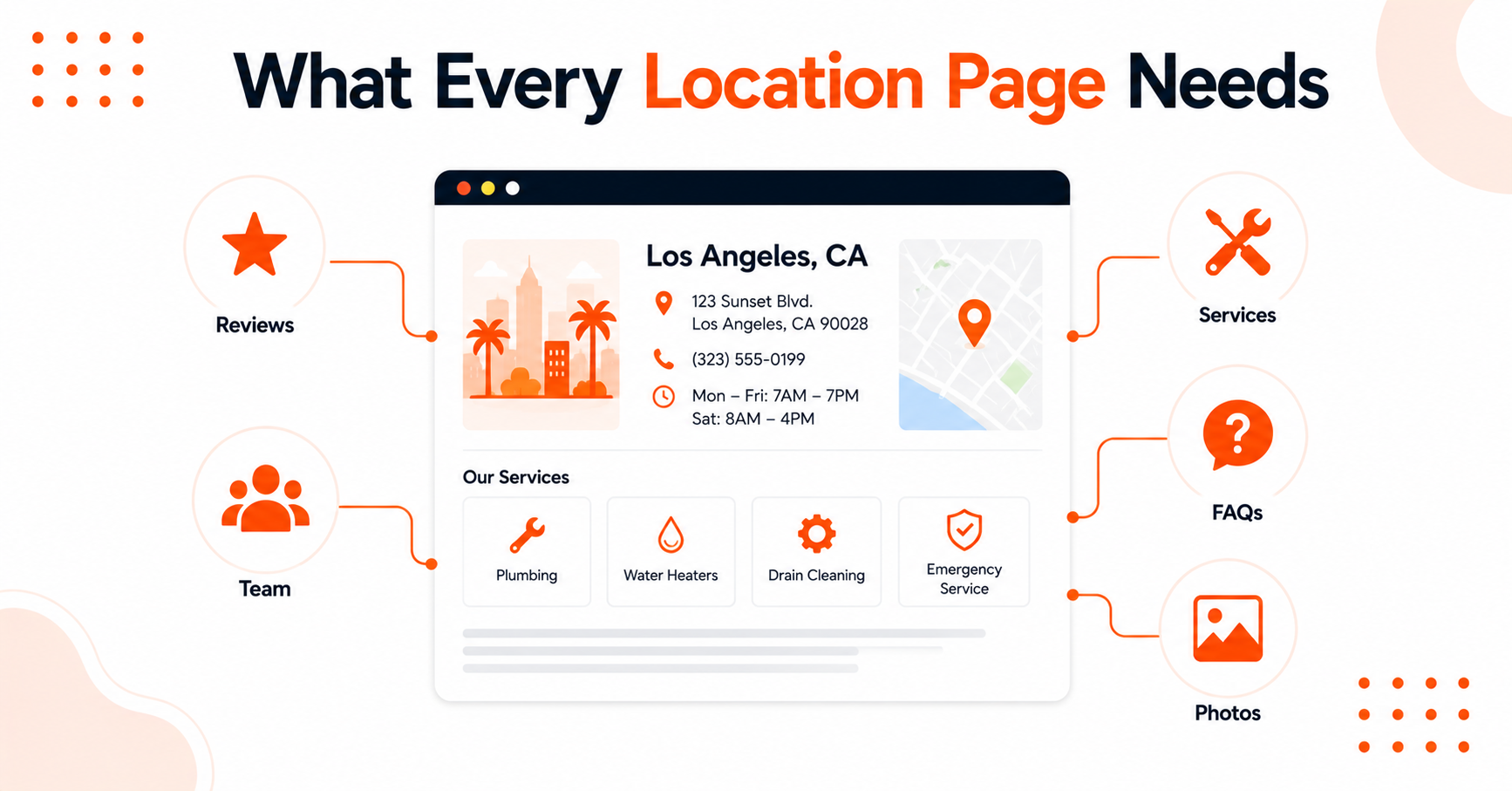
    Structure of a location page that earns customers trust.

    Google has seen that movie before, and it rarely ends well. To avoid search penalties, your location pages must provide unique content that offers genuine value to the user.

    Answer the Questions Customers Actually Have

    A high-performing landing page answers four questions quickly:

    1. What do you do?
    2. Where do you do it?
    3. Why should someone trust this branch?
    4. How does the customer contact the team today?

    If a busy parent or stressed homeowner cannot figure that out in ten seconds on a mobile device, the page needs work.

    Add Local Proof and Unique Content

    Use a repeatable layout, but fill it with local details. Add the branch name, address, phone number, hours, and service-specific copy infused with relevant local keywords to help you rank in your specific market.

    Include original photos, local testimonials, nearby landmarks, service-area notes, and team details when available. If one office handles same-day repairs and another does not, say it plainly.

    Optimize for Modern Search Behavior

    Search behavior has evolved. People still use Google, but they also ask full questions and expect immediate answers.

    Format each page to make information extraction easy, as this can help you capture valuable near me searches. Put common questions in headings and answer them in the first line or two.

    Short, direct answers often have a better chance of appearing in featured snippets, AI Overviews, and other answer-based results.

    Structured data helps too. Implementing LocalBusiness schema, service markup, and visible FAQs gives search engines a clearer understanding of each branch.

    While FAQ markup alone will not save a weak page, it reinforces your authority when the underlying content is strong.

    If you want a second source that lands in the same place, this multi-location SEO guide is a solid reference.

    Turn Profiles and Reviews Into Local Proof

    Your website is only half the story. For many service brands, Google Business Profiles and visibility on Google Maps are the first things potential customers see.

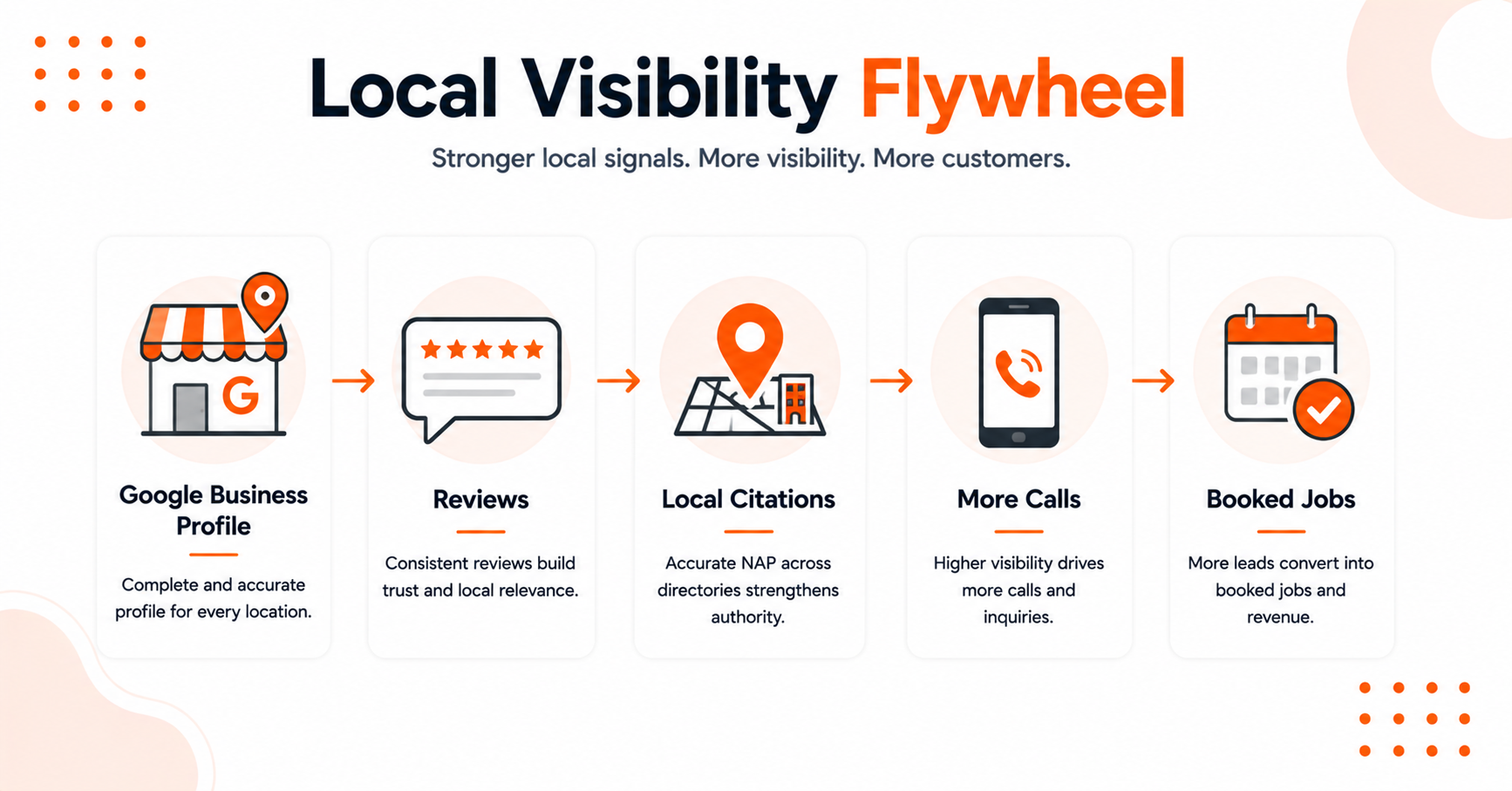
    Workflow of local visibility.

    Maintain Accurate Business Profiles

    Every physical location needs its own verified profile with the correct category, address, hours, services, photos, and call link.

    At 50-plus locations, small errors multiply quickly. One incorrect suite number or outdated phone line can lead to missed calls, duplicate listings, weak trust signals, and frustrated customers.

    Keep your NAP data consistent everywhere. That means the same business name, address, and phone format across your website, profiles, and major directories.

    Search engines do not like guessing, and neither do customers.

    Build a Review Generation Process

    Online reviews need a process, not a panic button. Ask for feedback immediately after the visit or completed job.

    Route the request to the correct branch and reply to every review using natural, human language. Mention the service naturally when it fits.

    A steady stream of recent feedback usually outperforms one large burst followed by months of silence.

    Expand Your Local Authority

    Build local proof around the web through chamber listings, supplier pages, trade associations, sponsorships, and community mentions.

    These local citations help build authority and confirm that a branch is real, active, and trusted. Strategic link building with local suppliers and associations is also an effective way to strengthen your footprint.

    Measure What Actually Matters

    Track what moves the business rather than what flatters the dashboard.

    Monitor:

    • Non-branded traffic by market
    • Calls
    • Form submissions
    • Booked jobs
    • Direction requests
    • Review velocity
    • Page-level conversion rates

    Rankings are nice, but market-level revenue is better.

    FAQs About Multi-Location SEO Strategy

    Below are a few questions related to the blog topic.

    How Many Location Pages Should a Large Service Brand Have?

    A large service brand should have dedicated location pages for each physical storefront or office. Once those pages are established, consider adding service-area or city-specific pages to target local keywords, but only when there is genuine search demand and enough unique local information to provide real value to the user.

    Can We Use Templates Without Creating Duplicate Content?

    Yes, you can use templates without creating duplicate content. Most large brands should rely on templates to maintain consistency across their site while keeping the content distinct.

    To avoid issues with duplicate content, customize every page with specific local proof, unique service details, authentic photos, regional customer reviews, and branch-specific FAQs. This approach helps ensure each of your location pages feels tailored to the community it serves.

    What Should We Measure Besides Rankings?

    Beyond rankings, you should measure incoming calls, booked jobs, direction requests, review growth, non-branded traffic by location, and the conversion rates of your location pages. These metrics provide a clearer picture of how your multi-location SEO strategy is impacting business performance.

    If a specific branch ranks well in search results but fails to generate qualified leads, it indicates that the page is not doing enough to convert local visitors into customers.

    Conclusion

    Managing fifty locations should not feel like juggling fifty separate marketing projects. The brands that win build one clean structure, one repeatable content system, and one reliable local data process, then give each branch the local proof that makes it credible and relevant.

    That is how organic visibility compounds over time. A successful multi-location SEO strategy focuses on building brand consistency, earning trust in every market, and creating sustainable search engine rankings that drive real business growth.

    Refresh helps multi-location businesses improve their online visibility through SEO, web design, and digital marketing strategies built for growth.

    So, if you need help scaling your local search presence across dozens of locations, schedule a call with Refresh.

  • Healthcare SEO Strategy That Turns Search Into Patient Leads

    Healthcare SEO Strategy That Turns Search Into Patient Leads

    Most healthcare organizations do not have a demand problem. Instead, they struggle with a visibility problem that often stems from an incomplete digital marketing strategy.

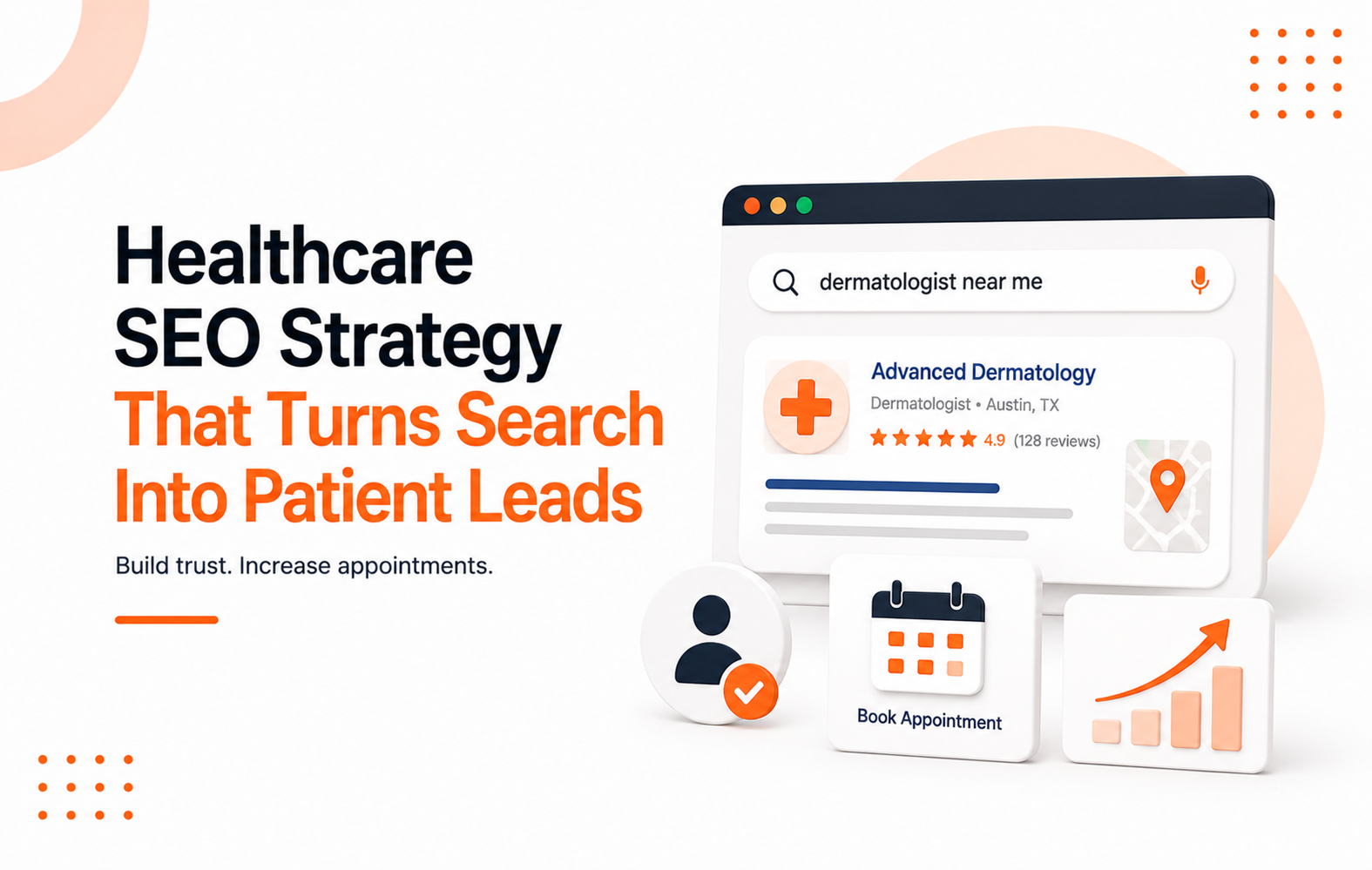
    Patients search, compare, read reviews, and size up trust before they ever make a call. If your brand does not show up in those critical moments, a competitor will secure the appointment. A strong healthcare SEO strategy fixes that by helping you appear where patients look first, then making it easy for them to take the next step.

    Key Takeaways

    • Patient leads usually start with real questions, local intent, and trust signals, not broad traffic goals.
    • Local SEO matters most for clinics, practices, med spas, dentists, and multi-location healthcare brands.
    • High-stakes health topics need stronger proof, clearer authorship, and better page quality than a typical business site.
    • The right strategy tracks calls, forms, booked visits, and direction requests to increase patient inquiries, rather than focusing on organic search ranking alone.

    Start With Patient Questions, Not Keywords Alone

    A successful healthcare SEO strategy begins with understanding user intent. You need to focus on what the patient is trying to solve right now by grounding your approach in thorough keyword research and a clear understanding of search intent.

    Sometimes the need is urgent, such as searches for urgent care near me. Other times, it involves careful research into specific procedures through long-tail keywords like botox for TMJ or dental implant recovery time.

    In other cases, the search is driven by trust, such as finding the best dermatologist in Austin or verifying whether a clinic accepts Aetna.

    This is your roadmap, not a giant keyword spreadsheet lacking context.

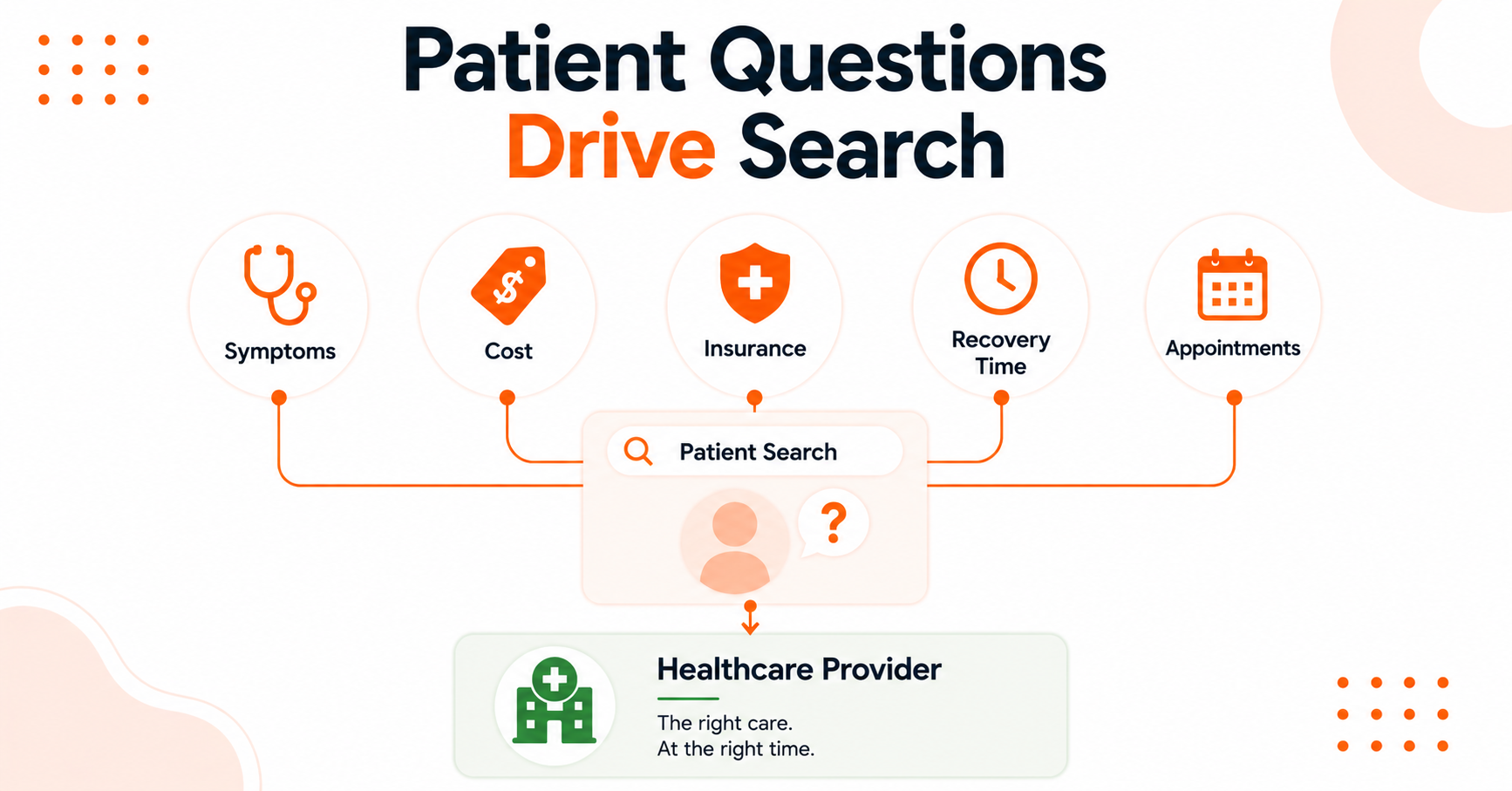
    Patient questions drive search illustration.

    Build your pages around those specific moments. Service pages should match treatment intent, while location pages should match local intent.

    Your FAQ pages should answer the exact questions your front desk hears every week. If patients consistently ask about insurance, recovery time, cost, side effects, or next available appointments, that content belongs on your site.

    Ultimately, your content quality is determined by how accurately and concisely you answer patient questions.

    Here is the part many teams miss: answer fast. Put the question in a heading and answer it within the first few lines.

    Do not make people wade through a paragraph about your company mission before telling them what they came to learn. That structure also helps search engines and AI-driven systems pull clean, credible excerpts from your page.

    Win Local Search Before You Chase Bigger Terms

    For most healthcare brands, mastering local SEO is the most reliable way to drive qualified traffic.

    Patients are rarely searching for healthcare services in the abstract. They are looking for a nearby provider that offers convenience, transparency, and an easy booking experience.

    To capture that intent, prioritize:

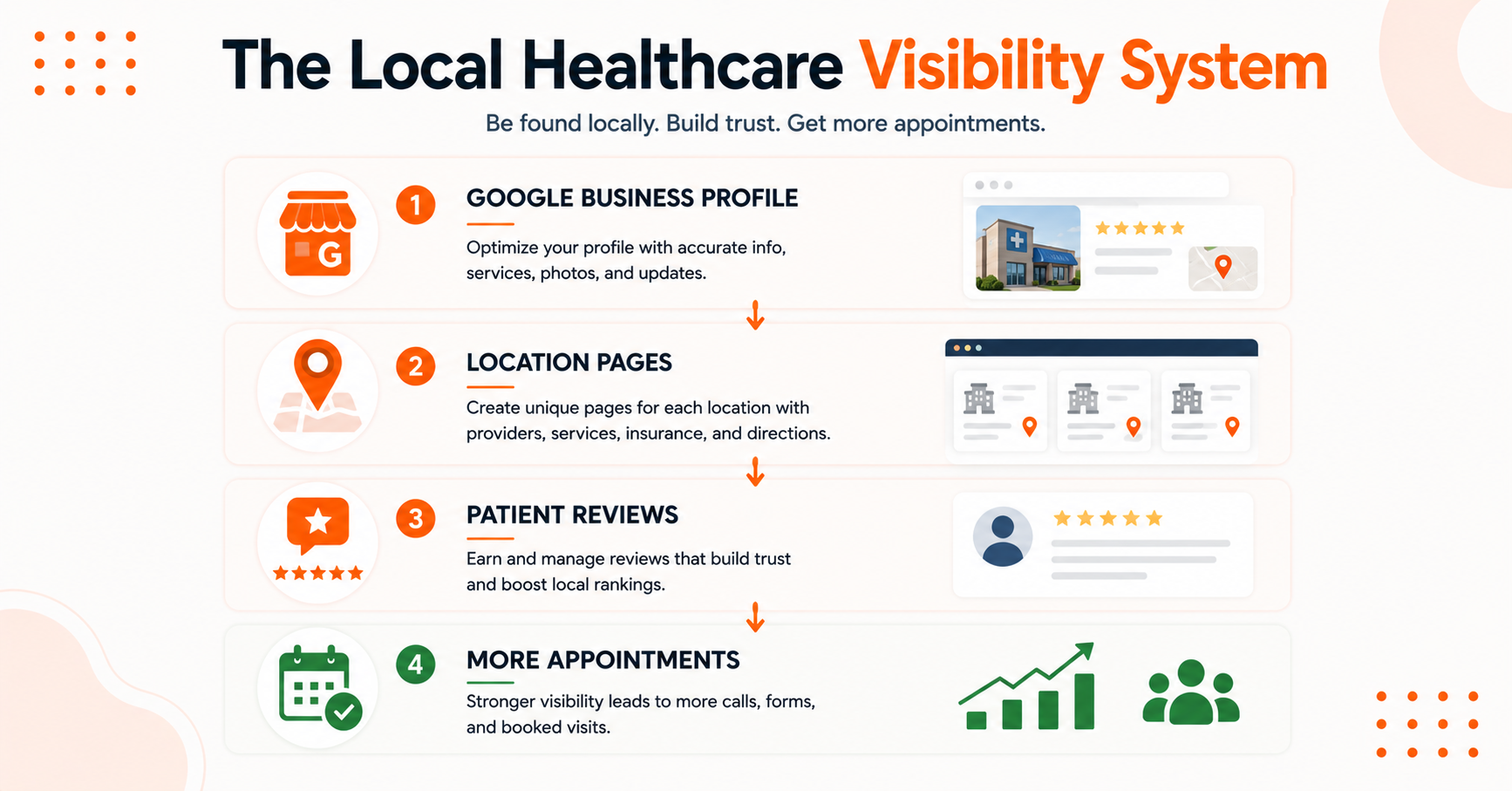
    • Google Business Profile optimization
    • Local landing pages
    • Review management

    Start with the fundamentals of NAP consistency. Ensure your name, address, and phone number are identical across every directory, social platform, and directory listing you control.

    Local healthcare visibility system.

    Beyond the basics, optimize provider pages for every location. Each office should have a unique page that includes:

    • Provider details
    • Service menus
    • Accepted insurance plans
    • High-quality photos
    • Clear directions

    When multiple offices are consolidated into one thin page, you fail to serve the specific needs of the local community. Focusing on unique location assets improves the user experience and makes it easier for patients to choose your practice.

    Reviews are equally important for both search visibility and conversion rates. A steady stream of fresh reviews signals that your practice is active, trusted, and reliable.

    When patients compare providers, they usually choose the one with recent, authentic feedback and a practice that responds like a human.

    If you want a second opinion on where the market is heading, these healthcare SEO examples for 2026 align closely with what leading healthcare brands are already doing to dominate local markets.

    Build Trust Into Every Page That Matters

    Healthcare content falls into a high-trust category often classified by Google as YMYL (Your Money Your Life). Because of this, search engines evaluate your site through the lens of E-E-A-T (Experience, Expertise, Authoritativeness, and Trustworthiness).

    Patients expect the same level of credibility. Thin pages, vague claims, and anonymous blog posts rarely perform well.

    Your treatment pages, provider bios, condition guides, and FAQ content should demonstrate clear medical expertise. Include licensed reviewers when appropriate, provide verified author information, and keep medical content up to date.

    Transparency also matters. Clear pricing information, office policies, and contact options help build trust with prospective patients.

    Your website must perform well from a technical standpoint, too. Fast site speed and mobile optimization are no longer optional because they directly affect the user experience.

    Effective healthcare SEO also includes:

    • Schema markup
    • Structured data for providers and locations
    • Review schema
    • FAQ schema where appropriate

    These elements help search engines interpret your content more effectively. However, they will not compensate for weak content.

    Securing backlinks from reputable healthcare organizations and medical journals can further strengthen domain authority. These signals help establish legitimacy and improve visibility in search results.

    This overview of technical SEO best practices for 2026 provides a useful benchmark for building a strong foundation.

    Finally, consider the modern search landscape. Patients no longer rely solely on traditional search results.

    AI overviews and answer boxes often influence decisions before a website visit ever occurs. To stay visible, create content that is easy to scan, easy to quote, and inherently trustworthy.

    Prioritize depth over volume. One well-structured page is far more valuable for SEO performance than several thin pages covering the same topic.

    Track Leads, Not Vanity Metrics

    Rankings feel good. Booked appointments are better.

    The strongest healthcare SEO programs measure outcomes such as:

    • Phone calls
    • Form submissions
    • Appointment requests
    • Direction clicks
    • Branded search growth

    Google Search Console and GA4 can reveal the path, but your CRM or scheduling data should close the loop.

    As you track these conversions, ensure your analytics setup maintains strict HIPAA compliance, whether you are managing data for a large health system or a private practice. If a page brings traffic but fails to generate patient action, it needs work.

    Content refreshes matter as well. Provider rosters change, office hours shift, insurance plans are updated, and medical guidance evolves quickly.

    When a page starts earning a strong organic search ranking, protect it. Prioritize content quality by updating information, strengthening internal links, and building supporting content around the topic.

    That is how organic traffic compounds over time, following the same principle behind building compounding organic traffic.

    FAQs About Healthcare SEO Strategy

    Below are additional questions you might ask.

    How Long Does Healthcare SEO Take to Work?

    Some healthcare SEO improvements can produce results within weeks, especially Google Business Profile updates, review generation, and location page enhancements. Larger gains typically take three to six months and continue building as your authority, relevance, and content depth grow.

    Maintaining high content quality is essential for turning those gains into sustainable long-term organic traffic.

    What Matters Most for Multi-Location Healthcare Brands?

    Each location needs its own strong page, accurate local listings, fresh reviews, and clear provider information. Shared boilerplate content across every office typically weakens visibility rather than improving it.

    Search engines prefer unique content that directly addresses the needs of the local community.

    Does AI Search Matter for Patient Acquisition?

    Yes, AI search matters for patient acquisition because AI overviews influence trust earlier in the patient journey. Even when they do not generate an immediate click, they help shape patient decisions during the research phase.

    If your pages answer questions clearly and demonstrate strong expertise, they are more likely to appear in these important early decision-making moments.

    e strong, well-structured page is significantly more effective for your SEO performance than five thin pages that cover the same ground.

    Turn More Healthcare Searches Into Patient Appointments

    Generating more patient leads does not happen by publishing random content and hoping that Google figures it out. Real growth comes from a disciplined medical SEO approach focused on earning patient trust through high-quality answers to specific health concerns.

    When you combine that credibility with a clear path to action, your website becomes a reliable resource for your community. That is the true objective of a strong healthcare SEO strategy: to be the clearest answer in the right place at the right time.

    If you want help identifying where patient demand is leaking and uncovering opportunities to attract more qualified patient inquiries, Book a call and get a second opinion on your healthcare SEO strategy.

  • SEO Strategy Professional Services That Brings Better Leads

    SEO Strategy Professional Services That Brings Better Leads

    Comprehensive search engine optimization is the foundation of modern digital marketing for firms, yet it remains expensive to fake. Getting better leads is the part that truly matters for your growth.

    A lot of professional services firms invest in search, then wonder why the right prospects still aren't showing up. The problem usually isn't effort. It's focus. If your SEO attracts researchers, students, and bargain hunters, you're building noise, not pipeline.

    The fix is simpler than most firms think. You need pages and content built for high-intent leads, trust, and action.

    Key Takeaways

    • A successful SEO strategy begins with a focus on high-quality lead generation rather than chasing vanity metrics or higher traffic volume.
    • Your top services should feature robust core pages backed by helpful content that addresses the specific questions your buyers are asking.
    • Creating content around bottom-funnel topics like costs, processes, timelines, fit, and comparisons helps attract better prospects and significantly improves the conversion rate of your website.
    • Trust signals carry more weight in professional services than almost anywhere else online.
    • Modern search experiences now include AI-generated answers, local listings, and customer reviews in addition to traditional search engine rankings.

    Why Most Firms Get Traffic but Not Leads

    Most firms do not have a search visibility problem. They have a matching problem. Their pages do not match what a ready-to-hire buyer is searching for when they need professional services.

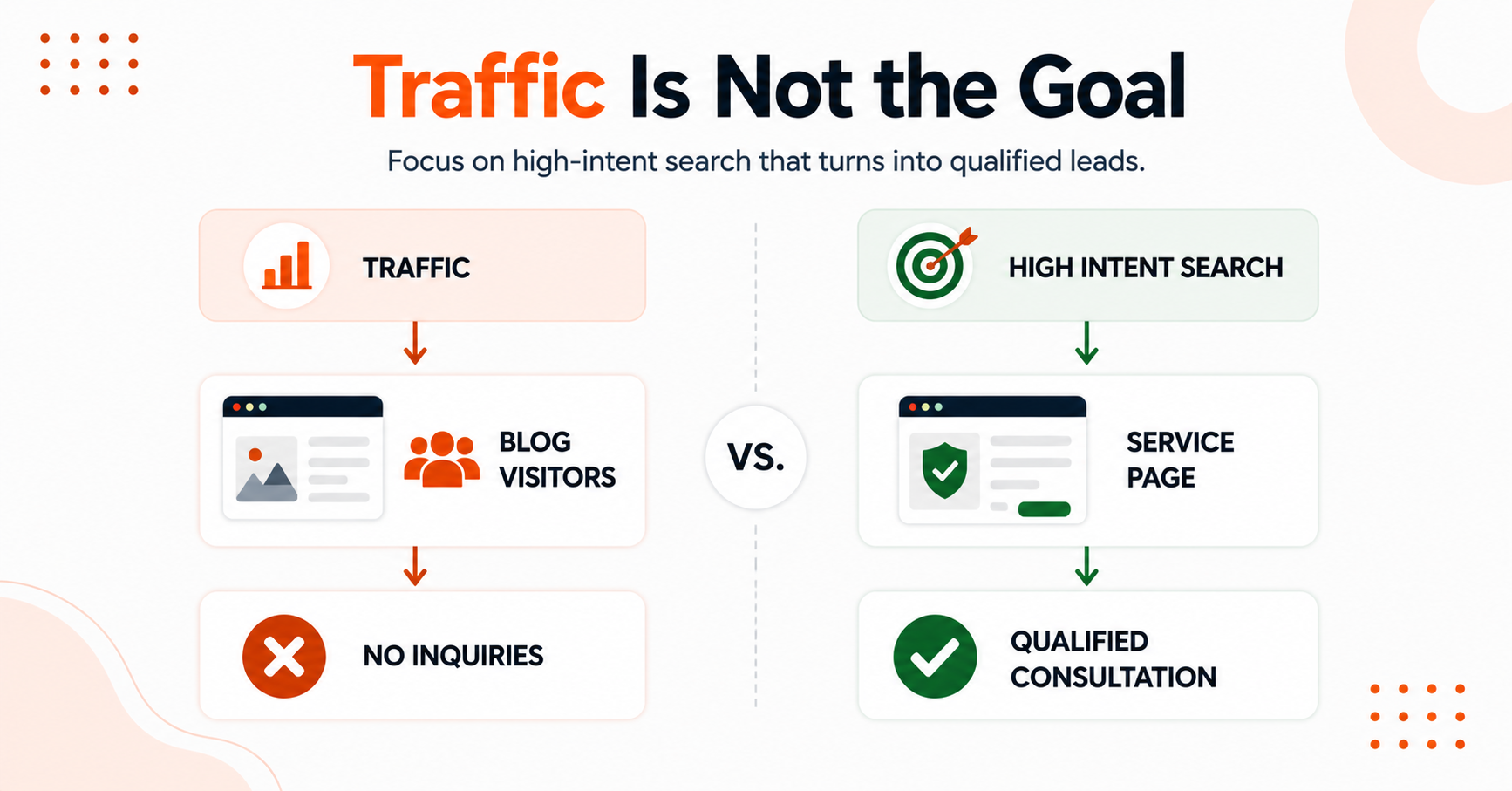
    SEO strategy comparing traffic focused content with high intent search that generates qualified leads.

    They talk about how someone hires a law firm, accounting firm, consulting firms, or other B2B advisory teams. They do not stay in research mode for long. They search by:

    • Service
    • Industry
    • Location
    • Cost
    • Timeline
    • Risk
    • Fit

    They want clarity fast, and they want a reason to trust you.

    That is why a strong SEO strategy for professional services firms does not start with blog volume. It starts with the services that drive revenue and the questions buyers ask right before they reach out.

    Broad traffic can still help, but it is secondary. Your organic search performance is about much more than just raw traffic numbers.

    A post with 5,000 visits and zero serious inquiries is a vanity project. A page with 80 visits and three qualified consultations is doing its job.

    Search is also changing. Buyers now see review sites, Google Business Profiles, AI summaries, and direct answers before they ever click through.

    If your content is vague, or if poor user experience and slow page speeds discourage visitors, you lose that visibility before the visit even happens.

    For a wider look at how SEO fits into a real growth mix, Hinge's guide to online lead generation techniques for professional services firms is a useful benchmark.

    What a Better SEO Strategy Looks Like

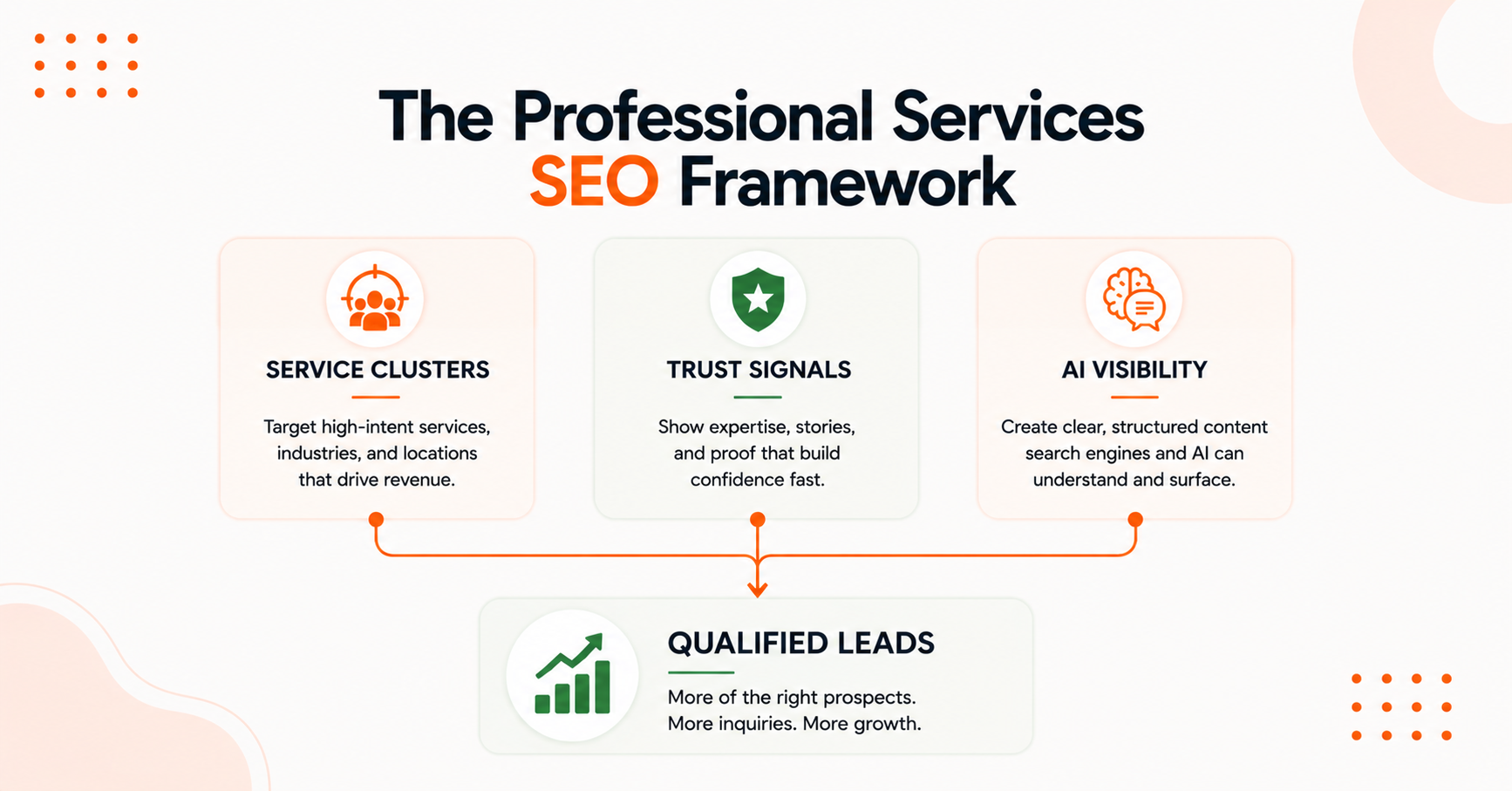
    What does the right setup look like? Three things:

    1. Tight service clusters
    2. Trust on every page
    3. Content that search engines and AI systems can understand quickly

    A simple way to think about it: wider search visibility should narrow into qualified leads.

    Professional services SEO framework connecting service clusters, trust signals, and AI visibility to qualified leads.

    Start With High-Intent Service Clusters

    The process begins with thorough keyword research to identify what your ideal clients are actually typing into search engines.

    Once you have your data, focus your on-page SEO by picking your top three services and building one strong page for each. Support these pages with content covering:

    • Cost
    • Process
    • Timeline
    • Common objections
    • Comparisons
    • FAQs

    If the search demand is there, build pages around service plus industry and service plus location. That matters for firms with niche expertise or regional reach.

    "Business valuation for dental practices" is stronger than "business valuation services." So is "estate planning attorney in Denver" if local intent is clear.

    This is where a lot of firms get boxed in. They publish general thought leadership and skip the commercial pages that turn interest into inquiry.

    You need both, but the money pages come first.

    Build Trust Into Every Page

    Professional services are trust purchases. People are not buying a product off a shelf; they are hiring judgment. You must demonstrate professional authority by featuring:

    • Partner bios
    • Credentials
    • Detailed case studies that prove your effectiveness

    Your pages need to cultivate trust, fast. Showcase testimonials, reviews, and examples of outcomes to help prospects understand:

    • Who you help
    • What the engagement looks like
    • How long it usually takes
    • Who is or is not a fit

    If a page ranks but does not build confidence, it will not bring better leads. Short FAQ sections help here too. They answer objections, tighten the page, and make your expertise easier for search engines and AI tools to interpret.

    That is a big deal in 2026, when more discovery happens inside answer engines and AI overviews.

    Write so Search and AI Can Quote You

    Clear headings, direct answers, and strong internal page structure are the foundation of your approach.

    Beyond content quality, you need a solid foundation of technical SEO, including correct schema implementation and reliable mobile responsiveness, to ensure your site performs well across all devices.

    You do not need fluffy content. You need useful, answer-first material written in plain English.

    That includes pages on:

    • Pricing
    • Process
    • Timelines
    • Risks
    • Alternatives
    • Who this is best for

    These topics often convert better than broad educational posts because they catch buyers closer to a decision.

    It also helps to build authority outside your site. Strategic link building is essential, as acquiring quality backlinks from reputable industry sources validates your site in the eyes of search algorithms.

    These off-site signals improve your overall search visibility. Rebus has a practical overview of lead generation for professional services firms that supports that broader view of combining high-quality content with.

    Measure Lead Quality, Not Pageviews

    Once the content is live, do not grade success by traffic alone. That is how firms keep funding SEO that looks busy but fails to generate results.

    To truly understand your performance, you must use data analytics to connect search behavior to actual business outcomes.

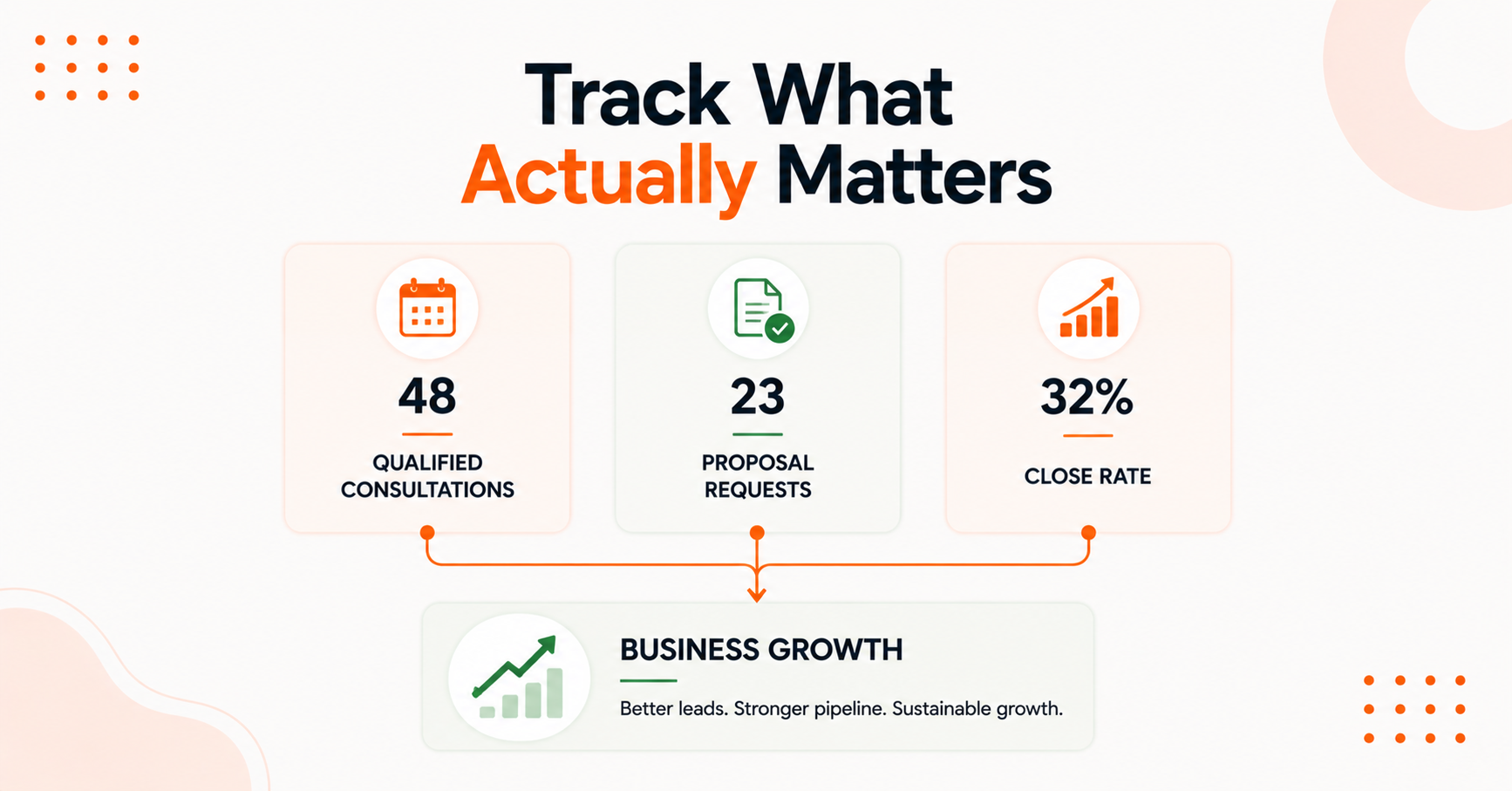
    SEO performance metrics focused on qualified consultations, proposal requests, and close rates.

    These metrics tell a better story:

    MetricWhy It MattersQualified consultationsShows intent and client fitProposal requestsConnects search directly to your pipelineClose rate by landing pageReveals which topics attract serious buyers

    Review these metrics monthly to evaluate the ROI of your marketing efforts. Cut topics that attract the wrong audience, and expand the pages that drive high-quality conversations.

    If you serve a local market, keep your Google My Business profile, client reviews, and location pages current to build local authority.

    Beyond search, leverage your LinkedIn presence to bolster professional credibility and nurture network-based leads that align with your organic search strategy.

    The broader objective is clear: paid traffic is rented, but organic visibility is a long-term asset. A well-optimized page can keep bringing in the right leads long after it goes live.

    FAQs

    Below are additional questions that might help you.

    How Long Does SEO Take for a Professional Services Firm?

    How Long Does SEO Take for a Professional Services Firm?

    Most firms start seeing meaningful movement in a few months, but better-fit lead flow usually takes longer. The timeline depends on competition, site quality, authority, and how fast you publish the right pages.

    Should We Focus on Blog Content or Service Pages First?

    Service pages should come first, almost every time. Blog content helps, but it should not come before the pages that explain what you do, who you help, and why someone should contact you.

    Do AI Overviews Change SEO for Professional Services?

    Yes, AI overviews change SEO for professional services by making content clarity and structure even more important. Your content needs to be clearer, more structured, and easier to quote.

    To rank well, you must demonstrate genuine expertise and establish authority within your niche. Direct answers, strong FAQs, proof, and clean page architecture matter more now.

    What Content Usually Brings the Best Leads?

    Bottom-funnel topics usually bring the best leads. Think cost, timeline, process, comparisons, common mistakes, risks, and fit.

    Creating these pages is a fundamental part of an effective search engine optimization plan for B2B firms. These topics attract people who are closer to hiring, not just browsing for information.

    It's Time for You to Have a Strong SEO Strategy

    Better leads do not come from simply publishing more content. They come from tighter search intent, stronger social proof, and pages specifically designed to convert visitors.

    A truly winning content strategy balances local SEO efforts with a broader national reach to ensure you are connecting with the right clients at the right time.

    If your firm wants organic visibility that compounds over time, you must focus on building a sustainable SEO strategy that acts as a long-term asset rather than chasing temporary spikes in traffic. By prioritizing high-value growth for professional services, you ensure that your digital presence works as hard as your team does.

    If you want help refining your approach across SEO, AI visibility, and video, schedule a call now!

  • A Smarter Ecommerce SEO Strategy for Large Catalog Brands

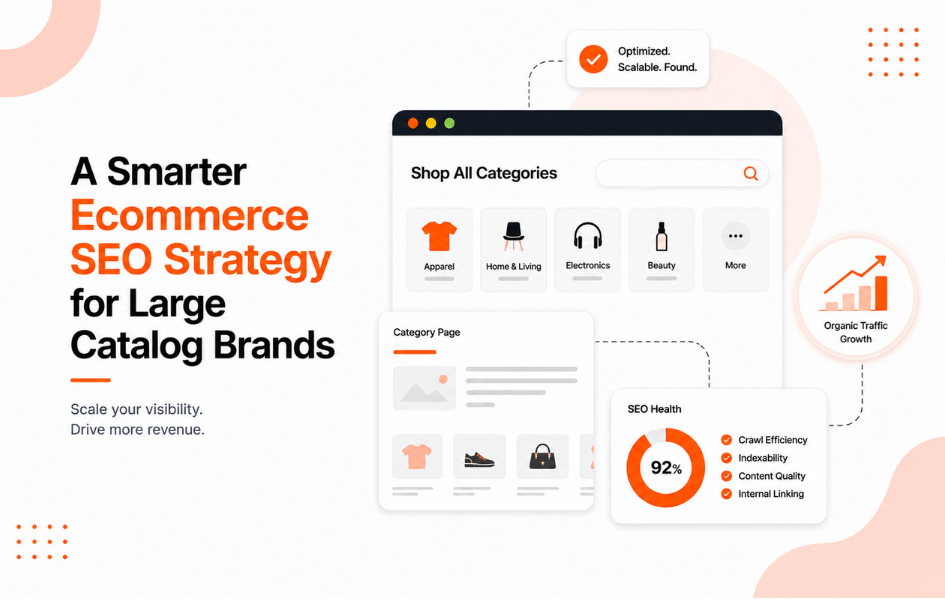
    A Smarter Ecommerce SEO Strategy for Large Catalog Brands

    A large product catalog can make your store look robust and authoritative while still leaving it virtually invisible to potential customers.

    When thousands of URLs pile up, search engines do not automatically see an opportunity for growth. Instead, they often encounter duplication, wasted crawl budget, and mixed signals that prevent your site from capturing the organic traffic it deserves.

    That is why a serious ecommerce SEO strategy for a large catalog must be built on scalable systems rather than one-off page edits.

    Key Takeaways

    • Large catalogs win when category pages act as the foundation for your overall ecommerce SEO strategy.
    • Mastering technical SEO is just as critical as on-page optimization for managing expansive product databases.
    • Strong, scalable templates produce more consistent results than relying on random manual fixes.
    • Not every filter, product variant, or low-value page deserves to be indexed by search engines.
    • Long-term success requires alignment between your content efforts and the specific search intent of your customers.
    • The most effective SEO programs prioritize resources based on potential revenue rather than total URL count.

    Start With Architecture, Not More Pages

    Most large ecommerce sites do not have a content problem. They have a site architecture problem.

    Your category pages should function like commercial landing pages, crafted around rigorous keyword research to ensure they meet user intent. They need a clear purpose, clean URLs, strong internal links, and copy that helps shoppers narrow the field. If those pages are thin, buried, or cannibalized by filter URLs, rankings stall fast.

    Every product should sit inside a simple hierarchy. No weird detours. No five different paths to the same item. Search engines still use site structure as a major clue, and shoppers do too.

    That means fewer orphan pages, fewer internal dead ends, and more effective internal linking that pushes authority into the pages that can actually rank. A clean architecture also makes future growth easier. Add a new collection, brand, or season, and the site still makes sense.

    Here is the simple test: if a new team member cannot explain your category structure in two minutes, it is probably too messy.

    Protect Crawl Budget and Control Duplicate URLs

    This is where large catalogs go sideways, and where sound technical SEO becomes a necessity.

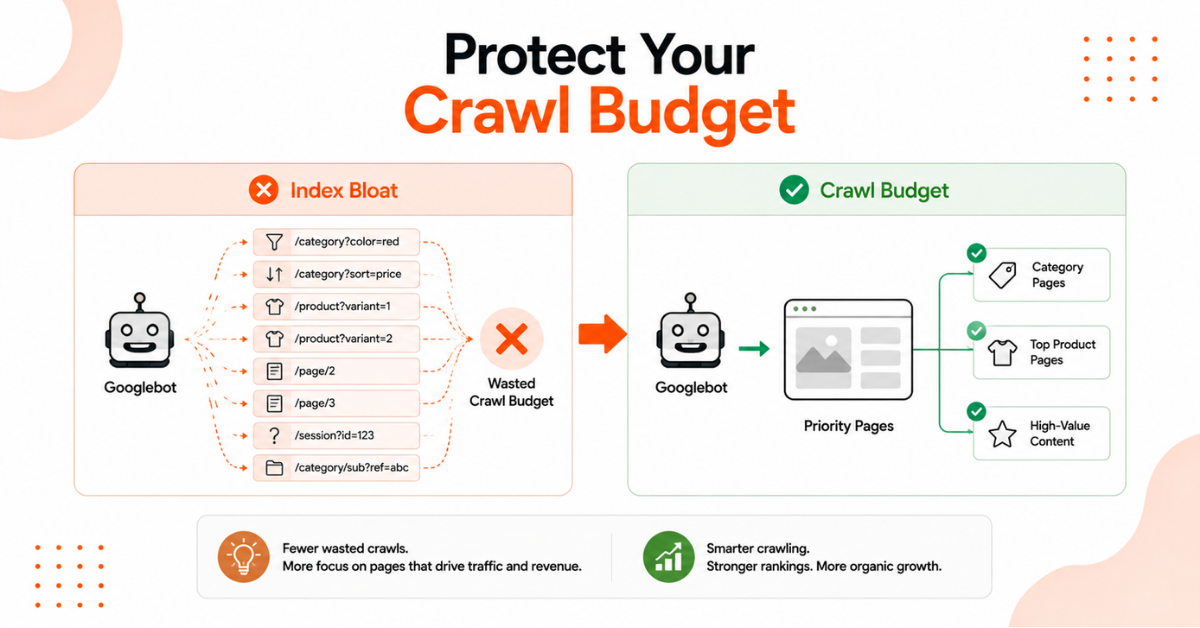
    Filters, sort orders, color variants, pagination, session parameters, and duplicate category paths can turn one product into a pile of near-identical URLs.

    Technical SEO diagram showing how crawl budget optimization improves indexing of priority pages.

    Common causes of index bloat include:

    • Filter combinations
    • Sort-order URLs
    • Product variants
    • Pagination issues
    • Session parameters
    • Duplicate category paths

    Search engines waste time on these variations, which means your priority pages receive less attention. If you allow this index bloat to continue, you will inevitably experience a drop in organic traffic.

    Large-catalog SEO is a prioritization problem first, and an optimization problem second.

    Use canonical tags where duplicate versions need to exist. Use noindex directives when a page helps users navigate your site but should not compete in search results.

    Keep faceted navigation indexable only when the filtered result matches real user demand and maintains enough stable inventory to deserve a dedicated landing page.

    Split your XML sitemap by page type to improve crawl efficiency. Monitor your performance in Google Search Console, and if you have the resources, review your server logs.

    You want search bots spending their time on your money pages, not on junk URL combinations.

    That matches the thinking in these scalable enterprise ecommerce SEO tactics. The big idea is simple: treat scale like a systems challenge, not a page-by-page checklist.

    Build Templates That Scale Without Feeling Thin

    You do not need handcrafted copy for 80,000 SKUs. You do need a strong template.

    Product Page Templates

    For product pages, that means moving beyond basic specs to create high-quality product descriptions.

    A scalable template should consistently include:

    • Optimized title tags
    • Meta descriptions
    • Image alt text
    • Schema markup
    • Structured data

    When possible, add differentiators buyers care about, such as sizing guidance, compatibility notes, materials, care instructions, or shipping details.

    Beyond text, remember that your pages must remain mobile-friendly and meet Core Web Vitals standards to ensure a seamless experience.

    Category Page Templates

    Category pages need templates too.

    Give them room for:

    • A short introduction
    • Featured brands
    • Common use cases
    • Internal links to top subcategories
    • Supporting FAQ content

    By incorporating user-generated content like customer reviews, you add social proof that helps both rankings and conversions.

    Furthermore, syncing your product data with Google Merchant Center is essential to maximize your visibility across search surfaces.

    Prepare for AI-Driven Search

    This is also where 2026 search looks different.

    Google's AI Overviews and answer engines pull directly from trustworthy, structured data. If your pages are vague or missing key attributes, they get skipped.

    Brands that win long-term do not just rank individual pages. They show up where customers ask questions and get instant answers.

    A solid template turns SEO into an asset. Paid traffic stops when the budget runs out, but a well-built catalog continues to drive results long after the work is done.

    For a broader look at how that plays out in online retail, this guide on how SEO affects ecommerce growth is worth a read.

    Prioritize by Revenue, Not by URL Count

    Now the strategic part.

    Not every page deserves the same effort. If your team treats a low-margin product and a top category the same way, you will stay busy and move slowly.

    That is not a growth plan. That is churn.

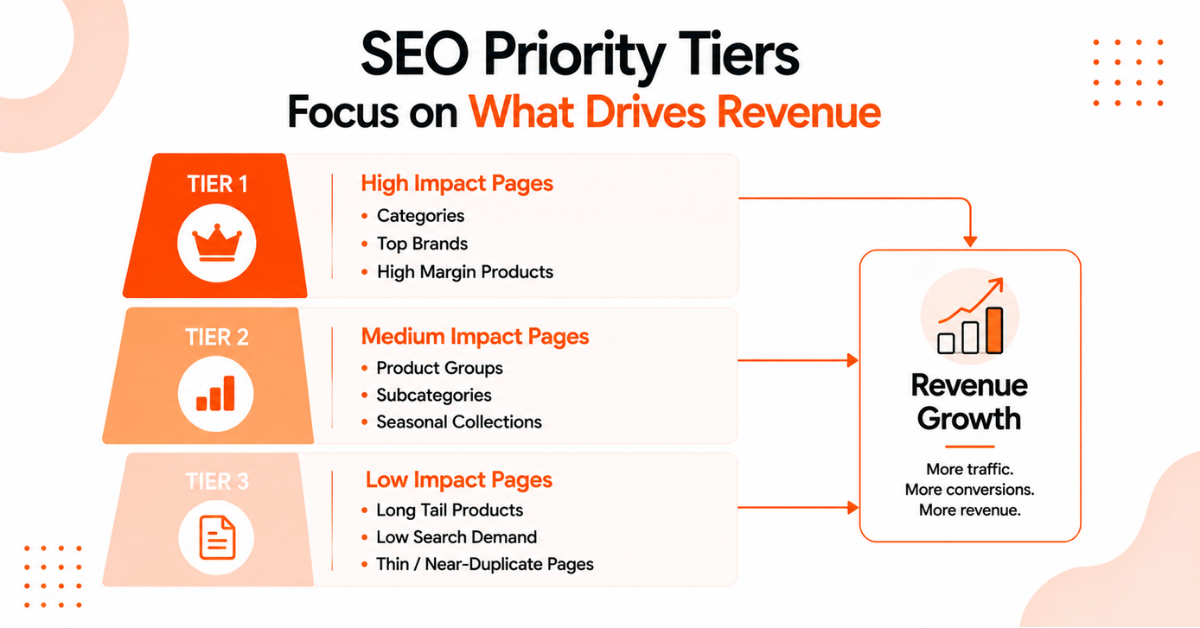
    Create SEO Priority Tiers

    Start by tiering your site.

    SEO priority framework showing high, medium, and low impact pages based on revenue potential.

    Tier 1 pages typically include:

    • Core category pages
    • Top brands
    • Highest-margin products
    • High-intent informational pages

    These Tier 1 pages should be carefully aligned with search intent and high-volume keywords identified during your keyword research.

    Because these pages are vital for your bottom line, they require a dedicated link building strategy to earn high-quality backlinks that boost authority and improve your store conversion rate.

    Lower-value pages can rely more on templates and rules.

    Align SEO With Merchandising

    Merchandising and SEO need to stay tied together here.

    If a product is seasonally out of stock, keep the page live when demand will return. If it is gone for good, redirect it to the closest replacement or category page.

    Do not leave dead ends everywhere and call it site maintenance.

    The brands pulling ahead are not always spending more. They are building a stronger organic engine, one that compounds over time and keeps showing up across search and AI-driven results.

    FAQs About Ecommerce SEO Strategy

    Below are additional questions that might help you.

    How Many Product Pages Need Unique Copy?

    Usually not all of them.

    Prioritize writing custom copy for high-demand, high-margin, or hard-to-differentiate product pages first. For the rest of your catalog, use better templates, richer data fields, reviews, and structured markup.

    This approach allows you to scale efficiently while still targeting specific long-tail keywords that drive qualified traffic to your site.

    Should Filter Pages Be Indexed?

    You should only index filter pages when the resulting view matches verified search demand and remains useful for users over time.

    Deciding which pages to include in the index should be a core component of your ongoing SEO audit. Most filter combinations should remain excluded from search results so they do not crowd out your primary category pages or dilute your site authority.

    What Should You Measure First?

    Start by tracking non-brand organic revenue, category page visibility, and indexation quality.

    You should also use keyword research to monitor SERP performance for specific title tags and meta descriptions across your highest-value page groups.

    While rankings are a useful signal, tracking revenue by template type provides the clearest indication of whether your strategy is delivering a tangible return on investment.

    Ready to Build a Stronger Ecommerce SEO Strategy?

    A massive catalog is not an SEO advantage by default. It is raw material.

    The brands that win turn that sprawl into structure, crawl rules, strong templates, and ruthless prioritization. By organizing your catalog effectively, you position your brand to dominate the SERP and capture high-intent searchers.

    Do that well, and organic growth starts to compound, providing a sustainable source of organic traffic that does not reset every month like paid advertising campaigns.

    Refresh helps brands turn complex catalogs into scalable SEO systems. If that sounds like the challenge you are facing, schedule a call to explore your next steps.