Blog

  • Law Firm Service Page SEO That Brings in Better Leads

    Law Firm Service Page SEO That Brings in Better Leads

    A law firm service page can rank well and still waste your intake team's time. Even if your site performs strongly in organic search results, you may still attract the wrong case types, the wrong locations, or people who were never going to hire counsel.

    In those situations, traffic numbers look good, but revenue remains stagnant. That is the real challenge that law firm service page SEO is designed to solve.

    The goal is not more clicks for the sake of it. It is about attracting better cases, generating more productive consultations, and filtering out junk leads before they reach your pipeline.

    This guide explains how to build practice area pages that align with search intent, improve lead quality, and support long-term growth for your law firm.

    Key Takeaways

    • High-converting practice area pages focus on one clear intent rather than mixing multiple topics.
    • The best pages answer the primary search intent quickly to satisfy users while establishing immediate trust.
    • Integrating local SEO signals with attorney credibility helps your firm stay visible in both traditional search results and AI-driven discovery.
    • Track qualified consultations and signed cases as your primary success metrics, rather than focusing on vanity metrics like rankings alone.

    Why Most Law Firm Service Pages Miss the Mark

    A lot of firms publish pages that read like brochures. They are polished enough, but completely forgettable because they focus on the firm's history, values, and broad capabilities before answering the one thing the searcher cares about: "Can you help with my exact legal problem, here, right now?"

    That mismatch is expensive.

    Someone searching for a truck accident lawyer in Phoenix does not want a vague personal injury page with six practice areas crammed into one template. Likewise, a parent looking for a child custody attorney should not have to dig through a generic family law overview.

    Search intent is almost always narrower than most law firm sites admit. By failing to create specific practice area pages, firms often miss the opportunity to connect with clients at the exact moment of need.

    Because legal content falls into the YMYL (Your Money or Your Life) category, search engines hold your site to a higher standard. You must demonstrate E-E-A-T (Experience, Expertise, Authoritativeness, and Trustworthiness) on every page.

    Through thoughtful keyword research, you can identify the specific terms your clients are actually using. This helps you avoid the one-page-fits-all trap and ensures your content aligns with what searchers are looking for.

    A service page should attract the right case and repel the wrong one.
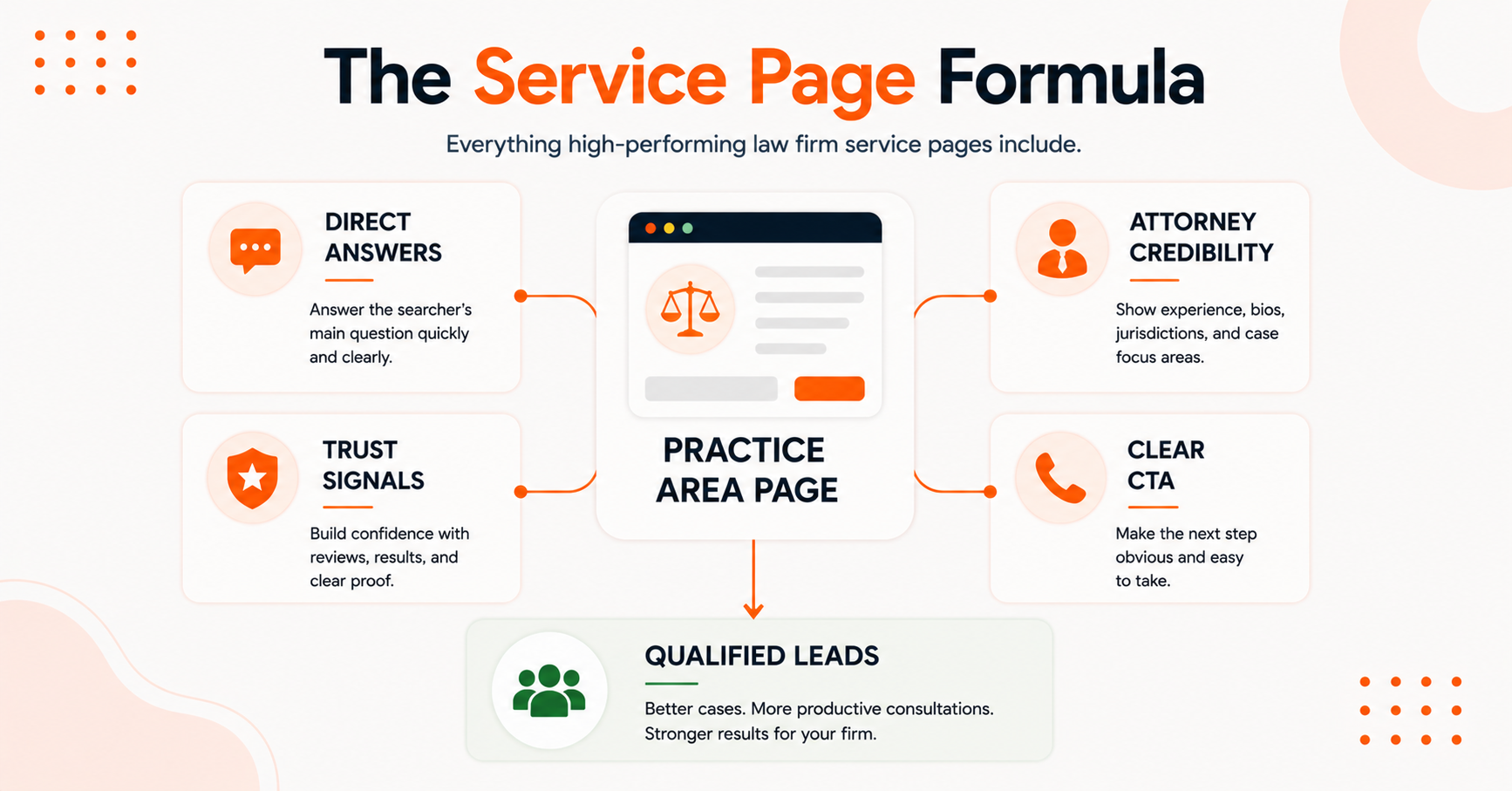
    Service page formula showing direct answers, trust signals, attorney credibility, and clear calls to action that generate qualified legal leads.

    That is why one-page-fits-all rarely works. Separate pages make sense whenever the case type, urgency, or location changes the searcher's question.

    Examples include:

    • Plaintiff law
    • Defense law
    • Family law
    • Criminal law
    • Estate law
    • Business law

    Each practice area has its own language, stakes, and conversion triggers.

    There is a bigger shift happening as well. People still search Google, but they increasingly ask AI tools direct questions.

    Clean structure, direct answers, and consistent facts help your firm appear in both places. These specific pages also create valuable opportunities for local SEO improvements, helping you capture relevant traffic within your geographic area.

    If you want the bigger picture on how search supports attorney lead flow, you can use internal linking to direct readers to MyCase's guide to attorney lead generation as a useful reference point.

    What High-Performing Law Firm Service Pages Include

    Start with the first screen of the page. It should immediately explain what you do, who you help, and where you help them.

    If someone lands on your DUI page, they should know within seconds whether the page covers first-time offenses, felony charges, license issues, or all of the above.

    Then get to the answer early. Not in paragraph seven. Right away.

    A strong opening section often accomplishes three things in fewer than 100 words:

    1. Names the problem.
    2. Explains when legal help makes sense.
    3. Tells the reader what the next step looks like.

    That structure helps people make decisions. It also helps search engines and AI systems lift a clean answer from the page.

    After that, the page needs proof. Not fluff, proof.

    Examples of strong trust signals include:

    • Detailed attorney bios
    • Years of experience
    • Jurisdictions served
    • Process details
    • Case types handled
    • Carefully presented reviews or results where ethics rules allow

    These attorney bios are especially important because they show potential clients the human expertise behind the firm. If your state bar has strict advertising rules, make sure every claim complies with them.

    A good service page also makes the next action obvious to support your conversion rate optimization strategy. Include a clear phone number, contact form, and office location.

    Tell readers exactly what happens after they contact the firm. Removing uncertainty often improves conversions.

    Finally, the technical side matters. Your pages need to load quickly and work flawlessly on mobile devices.

    Effective on-page optimization requires:

    • Managing Core Web Vitals
    • Implementing schema markup
    • Writing effective title tags
    • Creating compelling meta descriptions

    These elements help search engines interpret your content and improve visibility in search results. However, schema markup will not save weak writing. The page still has to answer first and prove second.

    Write for Search Intent, Not for Your Org Chart

    Many law firms build pages around internal organizational structures rather than the phrases real clients use. Your firm may think in departments, but prospective clients think in terms of specific legal problems.

    To bridge that gap, prioritize search intent. Conduct thorough keyword research to identify the long-tail keywords that reflect how potential clients actually describe their situations.

    Instead of abstract branding, target action-oriented queries such as:

    • Probate lawyer near me
    • How long do I have to file after a car accident?
    • Child custody lawyer in Phoenix
    • Business litigation attorney near me

    Your service pages should mirror these questions and provide clear, direct answers in plain English.

    Effective on-page optimization also requires headings that reflect user questions. Rather than cramming multiple legal issues onto one page, organize your practice area pages into logical topic clusters.

    This improves user experience while helping you build topical authority in the eyes of search engines.

    To strengthen those clusters, use strategic internal linking between service pages, attorney bios, and supporting blog content. This creates a cohesive content ecosystem that guides visitors toward the information they need.

    Finally, incorporate visible FAQs into your page design. FAQs provide space to address common objections, timing concerns, and process questions without bloating the main copy.

    Keep the questions authentic, provide concise answers, and maintain a clean structure to maximize visibility in answer-based search results.

    Measure Lead Quality, Not Vanity Metrics

    If the page is doing its job, rankings are only part of the story. The more important question is whether it attracts the kinds of matters you want more of.
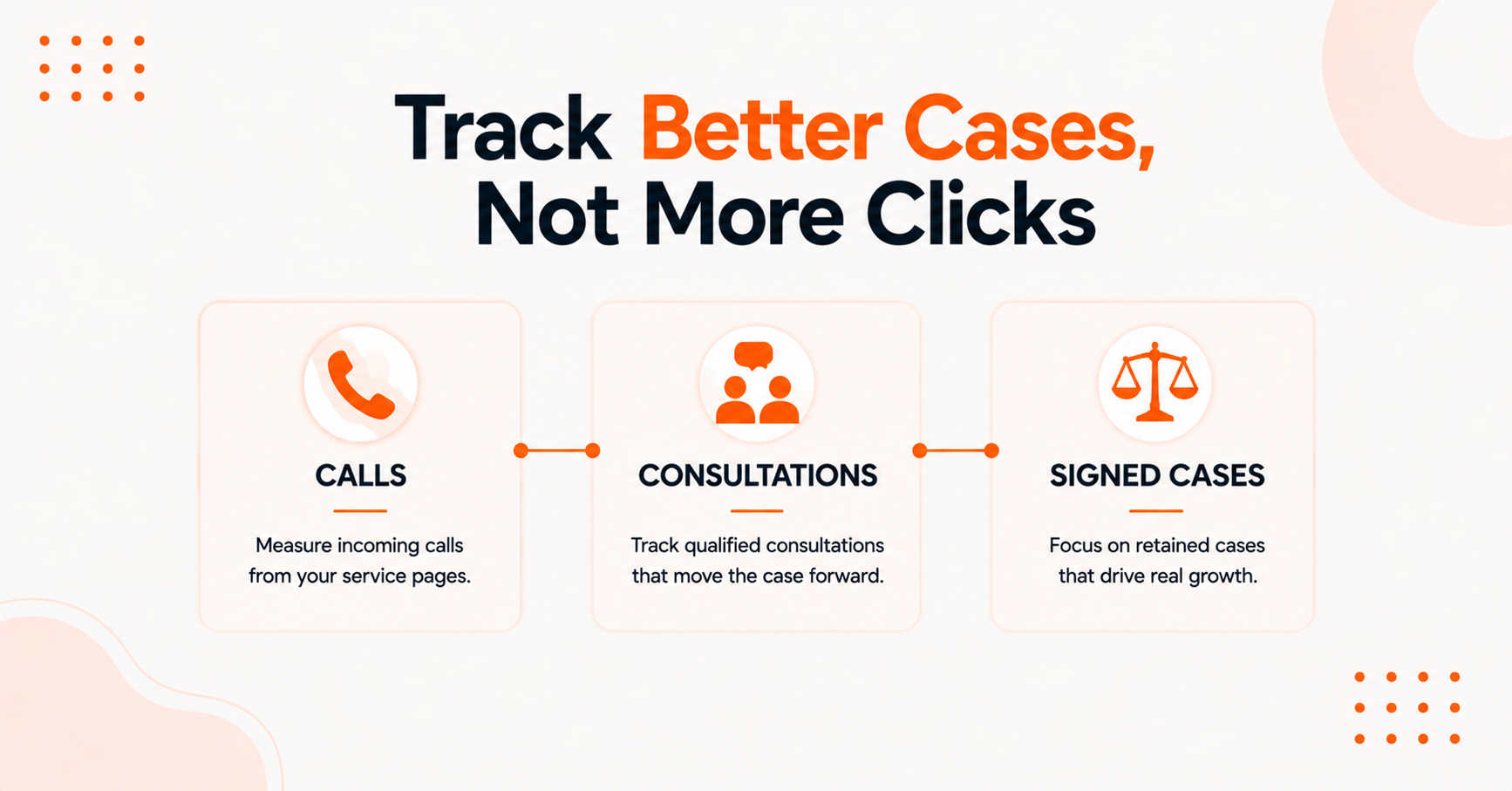
    Legal marketing funnel showing the progression from calls and consultations to signed cases and business growth.

    Track performance metrics such as:

    • Page-level calls
    • Form submissions
    • Consultation rates
    • Signed-case rates by practice area

    Tie your SEO data directly to intake outcomes. If your business litigation page generates fewer leads than a general business law page but consistently attracts better matters, that is still a win.

    This is also where patience matters. Service-page SEO is long-game work.

    While on-page optimization is essential, sustainable organic search results often require consistent link building from reputable legal directories to earn high-quality backlinks. Combined with a strong site architecture, these efforts create a compound effect over time.

    Unlike paid ads, which stop producing results when the budget ends, a well-optimized page can continue earning trust, traffic, and consultations month after month.

    For a realistic view of timing and legal marketing expectations, this law firm SEO strategy guide provides a fair baseline.

    When a page earns impressions but struggles to convert, do not scrap it immediately. Start by improving the user experience and auditing your technical SEO.

    Focus on:

    • Tightening the opening section
    • Clarifying case fit
    • Strengthening the call to action
    • Adding stronger trust signals
    • Refreshing FAQs

    Small, iterative improvements can quickly change the quality of leads and help the page perform better over the long term.

    FAQs About Law Firm Service Page SEO

    Here are a few more questions that may help you.

    Should Each Practice Area Have Its Own Page?

    Usually, yes. If the search intent is different, the page should be different too.

    Divorce, child custody, DUI defense, probate, and breach of contract are not the same search. By conducting thorough keyword research, you can determine whether the search volume justifies separate pages or if broader terms can be grouped.

    Distinct pages allow for better targeting and demonstrate deeper expertise in specific legal areas.

    Can One Service Page Target Multiple Cities?

    Yes, but only to a point. If each city has meaningful search demand, separate pages are often the better option.

    When targeting specific areas, ensure your Google Business Profile is optimized for each location. Maintaining strict NAP consistency (Name, Address, Phone) across your website and legal directories is essential for local SEO.

    These signals are critical for earning a spot in the local map pack, which is often the most valuable real estate for capturing local leads.

    Do FAQs Still Help Law Firm Service Pages?

    Yes, FAQs still help law firm service pages by providing fast answers and creating clearer structure for search systems. The questions should be visible on the page and written for real clients rather than bots.

    Using keyword research to identify common client pain points helps ensure your FAQs directly address what potential leads are searching for online.

    How Long Does Service Page SEO Take for a Law Firm?

    Some service page SEO improvements can produce results within weeks, especially on pages that already have impressions. Simple updates, such as improving title tags and meta descriptions, can provide an immediate boost in click-through rates.

    However, broader success with local SEO typically takes months because building authority, relevance, and trust is a cumulative process that develops over time.

    Turn More Service Page Traffic Into Qualified Legal Leads

    The best law firm service pages do not try to appeal to everyone. They focus on one legal problem, one type of client, and one clear next step.

    A successful legal marketing strategy combines local SEO, high-intent practice area pages, and content that aligns with search intent. When paired with strategic link building, authoritative backlinks, and strong trust signals, these pages can attract better-qualified leads and support long-term growth.

    That is where Refresh can help. Refresh is a digital marketing agency that helps law firms improve search visibility, strengthen their online presence, and generate higher-quality leads through SEO-driven content and website optimization.

    If your pages rank but your intake team is still fielding the wrong calls, it may be time to take a closer look at the strategy behind the traffic. Book a call with Refresh to discover opportunities to improve your service pages, attract better cases, and turn more visitors into qualified consultations.
  • Healthcare SEO Strategy That Turns Search Into Patient Leads

    Healthcare SEO Strategy That Turns Search Into Patient Leads

    Most healthcare organizations do not have a demand problem. Instead, they struggle with a visibility problem that often stems from an incomplete digital marketing strategy.

    Patients search, compare, read reviews, and size up trust before they ever make a call. If your brand does not show up in those critical moments, a competitor will secure the appointment. A strong healthcare SEO strategy fixes that by helping you appear where patients look first, then making it easy for them to take the next step.

    Key Takeaways

    • Patient leads usually start with real questions, local intent, and trust signals, not broad traffic goals.
    • Local SEO matters most for clinics, practices, med spas, dentists, and multi-location healthcare brands.
    • High-stakes health topics need stronger proof, clearer authorship, and better page quality than a typical business site.
    • The right strategy tracks calls, forms, booked visits, and direction requests to increase patient inquiries, rather than focusing on organic search ranking alone.

    Start With Patient Questions, Not Keywords Alone

    A successful healthcare SEO strategy begins with understanding user intent. You need to focus on what the patient is trying to solve right now by grounding your approach in thorough keyword research and a clear understanding of search intent.

    Sometimes the need is urgent, such as searches for urgent care near me. Other times, it involves careful research into specific procedures through long-tail keywords like botox for TMJ or dental implant recovery time.

    In other cases, the search is driven by trust, such as finding the best dermatologist in Austin or verifying whether a clinic accepts Aetna.

    This is your roadmap, not a giant keyword spreadsheet lacking context.

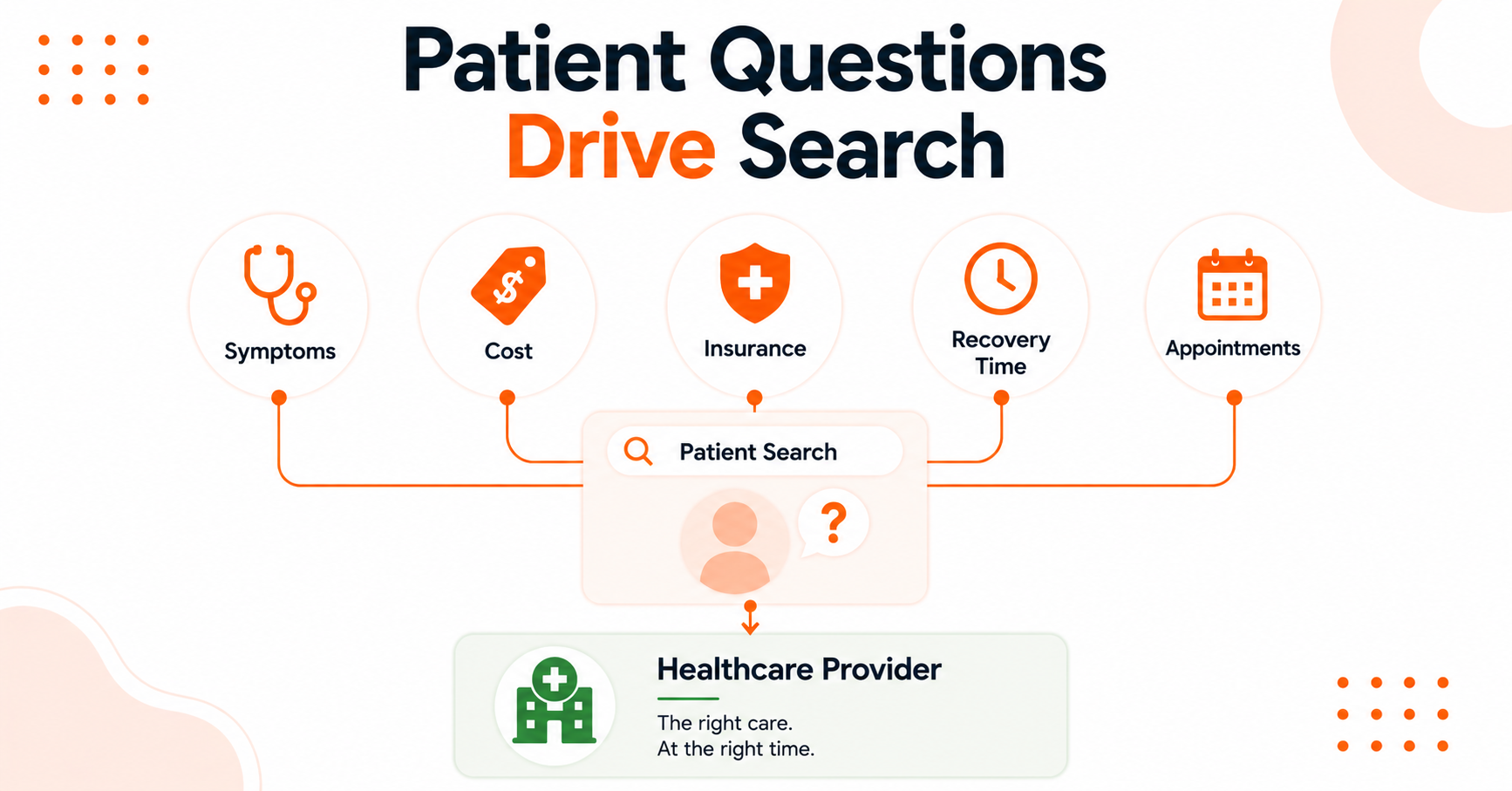
    Patient questions drive search illustration.

    Build your pages around those specific moments. Service pages should match treatment intent, while location pages should match local intent.

    Your FAQ pages should answer the exact questions your front desk hears every week. If patients consistently ask about insurance, recovery time, cost, side effects, or next available appointments, that content belongs on your site.

    Ultimately, your content quality is determined by how accurately and concisely you answer patient questions.

    Here is the part many teams miss: answer fast. Put the question in a heading and answer it within the first few lines.

    Do not make people wade through a paragraph about your company mission before telling them what they came to learn. That structure also helps search engines and AI-driven systems pull clean, credible excerpts from your page.

    Win Local Search Before You Chase Bigger Terms

    For most healthcare brands, mastering local SEO is the most reliable way to drive qualified traffic.

    Patients are rarely searching for healthcare services in the abstract. They are looking for a nearby provider that offers convenience, transparency, and an easy booking experience.

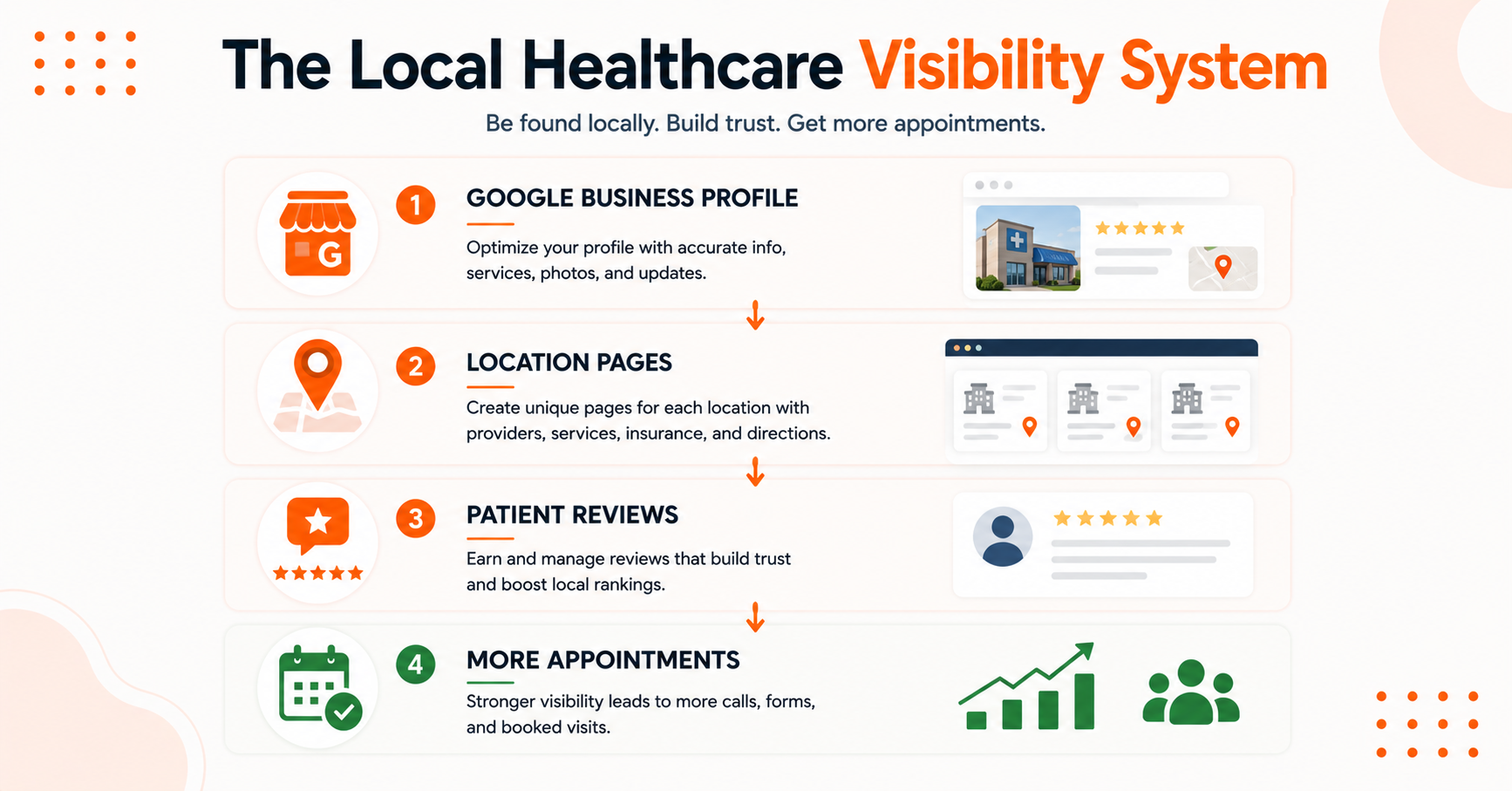
    To capture that intent, prioritize:

    • Google Business Profile optimization
    • Local landing pages
    • Review management

    Start with the fundamentals of NAP consistency. Ensure your name, address, and phone number are identical across every directory, social platform, and directory listing you control.

    Local healthcare visibility system.

    Beyond the basics, optimize provider pages for every location. Each office should have a unique page that includes:

    • Provider details
    • Service menus
    • Accepted insurance plans
    • High-quality photos
    • Clear directions

    When multiple offices are consolidated into one thin page, you fail to serve the specific needs of the local community. Focusing on unique location assets improves the user experience and makes it easier for patients to choose your practice.

    Reviews are equally important for both search visibility and conversion rates. A steady stream of fresh reviews signals that your practice is active, trusted, and reliable.

    When patients compare providers, they usually choose the one with recent, authentic feedback and a practice that responds like a human.

    If you want a second opinion on where the market is heading, these healthcare SEO examples for 2026 align closely with what leading healthcare brands are already doing to dominate local markets.

    Build Trust Into Every Page That Matters

    Healthcare content falls into a high-trust category often classified by Google as YMYL (Your Money Your Life). Because of this, search engines evaluate your site through the lens of E-E-A-T (Experience, Expertise, Authoritativeness, and Trustworthiness).

    Patients expect the same level of credibility. Thin pages, vague claims, and anonymous blog posts rarely perform well.

    Your treatment pages, provider bios, condition guides, and FAQ content should demonstrate clear medical expertise. Include licensed reviewers when appropriate, provide verified author information, and keep medical content up to date.

    Transparency also matters. Clear pricing information, office policies, and contact options help build trust with prospective patients.

    Your website must perform well from a technical standpoint, too. Fast site speed and mobile optimization are no longer optional because they directly affect the user experience.

    Effective healthcare SEO also includes:

    • Schema markup
    • Structured data for providers and locations
    • Review schema
    • FAQ schema where appropriate

    These elements help search engines interpret your content more effectively. However, they will not compensate for weak content.

    Securing backlinks from reputable healthcare organizations and medical journals can further strengthen domain authority. These signals help establish legitimacy and improve visibility in search results.

    This overview of technical SEO best practices for 2026 provides a useful benchmark for building a strong foundation.

    Finally, consider the modern search landscape. Patients no longer rely solely on traditional search results.

    AI overviews and answer boxes often influence decisions before a website visit ever occurs. To stay visible, create content that is easy to scan, easy to quote, and inherently trustworthy.

    Prioritize depth over volume. One well-structured page is far more valuable for SEO performance than several thin pages covering the same topic.

    Track Leads, Not Vanity Metrics

    Rankings feel good. Booked appointments are better.

    The strongest healthcare SEO programs measure outcomes such as:

    • Phone calls
    • Form submissions
    • Appointment requests
    • Direction clicks
    • Branded search growth

    Google Search Console and GA4 can reveal the path, but your CRM or scheduling data should close the loop.

    As you track these conversions, ensure your analytics setup maintains strict HIPAA compliance, whether you are managing data for a large health system or a private practice. If a page brings traffic but fails to generate patient action, it needs work.

    Content refreshes matter as well. Provider rosters change, office hours shift, insurance plans are updated, and medical guidance evolves quickly.

    When a page starts earning a strong organic search ranking, protect it. Prioritize content quality by updating information, strengthening internal links, and building supporting content around the topic.

    That is how organic traffic compounds over time, following the same principle behind building compounding organic traffic.

    FAQs About Healthcare SEO Strategy

    Below are additional questions you might ask.

    How Long Does Healthcare SEO Take to Work?

    Some healthcare SEO improvements can produce results within weeks, especially Google Business Profile updates, review generation, and location page enhancements. Larger gains typically take three to six months and continue building as your authority, relevance, and content depth grow.

    Maintaining high content quality is essential for turning those gains into sustainable long-term organic traffic.

    What Matters Most for Multi-Location Healthcare Brands?

    Each location needs its own strong page, accurate local listings, fresh reviews, and clear provider information. Shared boilerplate content across every office typically weakens visibility rather than improving it.

    Search engines prefer unique content that directly addresses the needs of the local community.

    Does AI Search Matter for Patient Acquisition?

    Yes, AI search matters for patient acquisition because AI overviews influence trust earlier in the patient journey. Even when they do not generate an immediate click, they help shape patient decisions during the research phase.

    If your pages answer questions clearly and demonstrate strong expertise, they are more likely to appear in these important early decision-making moments.

    e strong, well-structured page is significantly more effective for your SEO performance than five thin pages that cover the same ground.

    Turn More Healthcare Searches Into Patient Appointments

    Generating more patient leads does not happen by publishing random content and hoping that Google figures it out. Real growth comes from a disciplined medical SEO approach focused on earning patient trust through high-quality answers to specific health concerns.

    When you combine that credibility with a clear path to action, your website becomes a reliable resource for your community. That is the true objective of a strong healthcare SEO strategy: to be the clearest answer in the right place at the right time.

    If you want help identifying where patient demand is leaking and uncovering opportunities to attract more qualified patient inquiries, Book a call and get a second opinion on your healthcare SEO strategy.

  • International SEO for Direct-to-Consumer (DTC) Brands Entering New Markets

    International SEO for Direct-to-Consumer (DTC) Brands Entering New Markets

    Launching in a new country via cross-border DTC strategies can feel like opening a second storefront in the dark. You know demand exists, but if search engines, AI models, and your target customers cannot interpret your site architecture correctly, you remain invisible.

    Successfully executing international SEO for DTC brands is not merely a translation project. It is a comprehensive market entry system. When direct-to-consumer businesses prioritize the right structure, language, and regional buying experience, they create a foundation for sustainable organic traffic growth that compounds long after the initial launch.

    Key Takeaways

    • Prioritize markets that already demonstrate organic demand rather than those that simply sound promising during planning meetings.
    • Choose a site structure you can maintain for the long term, as the foundation of your technical SEO is what ensures long-term scalability and AI readiness.
    • Move beyond basic translation to implement full content localization, ensuring that currency, shipping logistics, payment methods, and trust signals are tailored to the local audience.
    • Utilize hreflang tags, clean site architecture, and structured data so search engines and AI tools can accurately match the correct page to the right market.
    • Measure your success by analyzing country-level traffic, conversion rates, and revenue, rather than relying solely on aggregate global sessions.

    Choose the Right Markets First

    Many brands choose their next move based on geography, but a smarter approach relies on market prioritization driven by data.

    Before you invest, check your Google Search Console to see where you are already receiving organic traffic, repeat customers, branded searches, or shipping demand. If countries like Canada, the UK, or Germany already appear in your analytics, they represent a much safer foundation for expansion than attempting to plant flags in random territories simultaneously.

    Market expansion framework using demand signals to prioritize international SEO growth.

    Keep your first phase tight. One to three markets is usually the sweet spot for a successful launch because it gives you enough focus to learn what works, resolve technical issues, and avoid building five half-finished country experiences.

    This strategic approach also fundamentally changes your keyword research. Do not simply port your U.S. keyword list into another language and call it a day.

    Search behavior shifts by country, even when the population speaks the same language. A phrase that converts in the U.S. may sound awkward or have low intent in Australia or the UK.

    Instead of relying on generic short-tail keywords, dig deeper to identify high-intent long-tail keywords specific to the nuances of each new region. By tailoring your content to these local search habits, you can establish a foundation for sustainable, predictable organic traffic growth.

    A useful outside reference for this process is this global SEO priority guide.

    Pick a Site Structure You Can Live With

    Now for the part that often leads to expensive technical debt, your domain architecture.

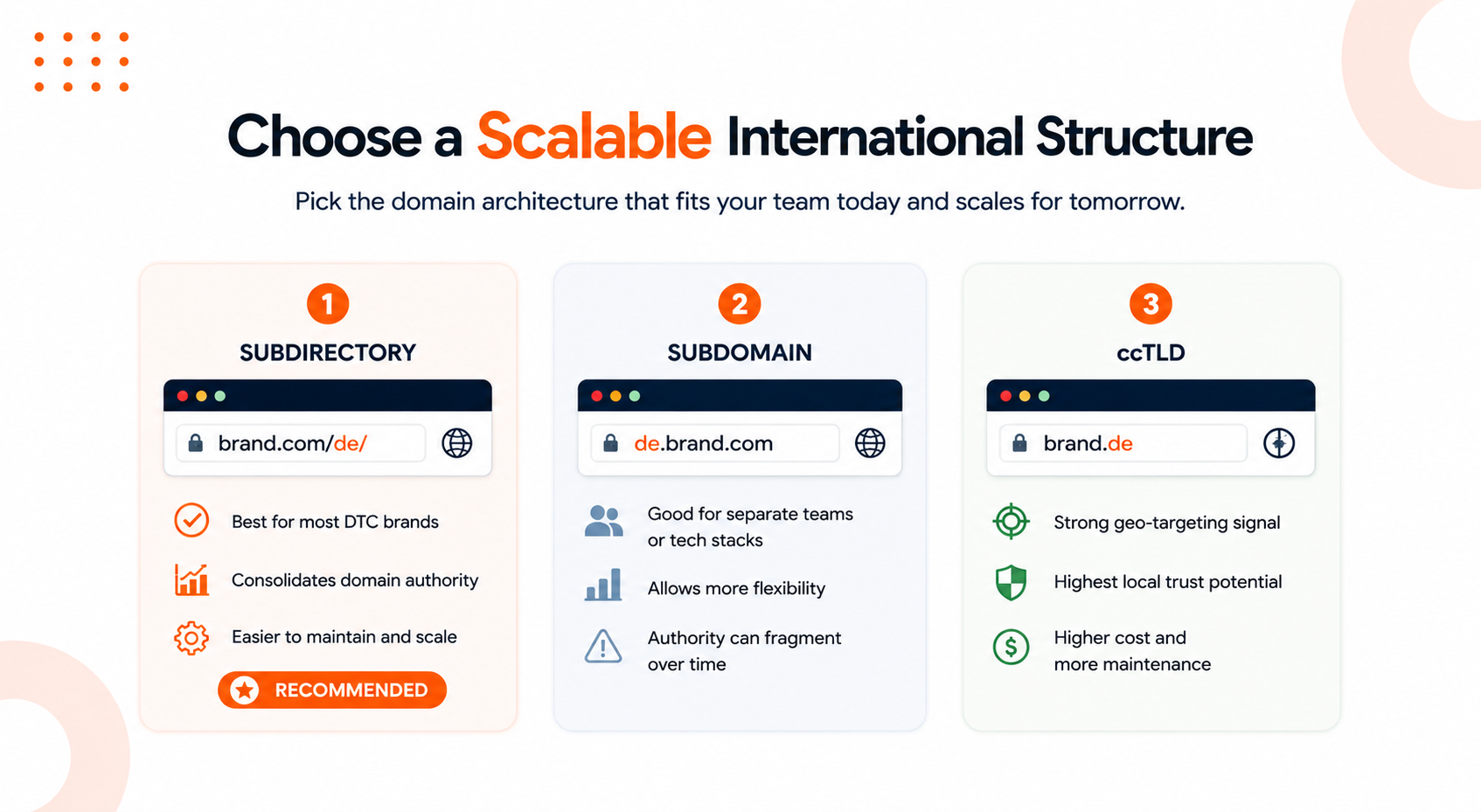
    You generally have three choices when planning your site architecture: subdirectories, subdomains, or country-code top-level domains. There is no perfect solution, only the option your team can maintain effectively.

    Here is a quick comparison:

    StructureExampleBest ForWatch Out ForSubdirectorybrand.com/de/Most DTC brandsNeeds clean hreflang and localization rulesSubdomainde.brand.comSeparate teams or tech stacksAuthority can fragmentccTLDbrand.deStrong country targetingHigher cost and more maintenance

    For most e-commerce SEO strategies, the subdirectory approach is the practical default. It is easier to maintain, simpler to scale, and keeps your domain authority consolidated. If you are using platforms like Shopify, Shopify Markets provides robust tools to manage these localized setups without needing a completely separate infrastructure.

    International SEO site structure comparison showing subdirectories, subdomains, and country specific domains.

    Regardless of the structure you choose, implementing hreflang correctly is a critical component of technical SEO. This tag tells Google which language and regional page is intended for a specific user. Without it, you risk serving the wrong version of your site, splitting search signals, and creating duplicate content issues that could have been avoided.

    If you want a second opinion on the basics, this international SEO overview for DTC brands covers the same core ingredients, including market-specific research, domain architecture, and localization.

    For most e-commerce SEO strategies, the subdirectory approach is the practical default. It is easier to maintain, simpler to scale, and keeps your domain authority consolidated.

    If you are using platforms like Shopify, Shopify Markets provides robust tools to manage these localized setups without needing a completely separate infrastructure.

    Regardless of the structure you choose, implementing hreflang correctly is a critical component of technical SEO. This tag tells Google which language and regional page is intended for a specific user.

    Without hreflang, you risk serving the wrong version of your site, splitting search signals, and creating duplicate content issues that could have been avoided.

    If you want a second opinion on the basics, this international SEO overview for DTC brands covers the same core ingredients, including market-specific research, domain architecture, and localization.

    Localize the Full Buying Journey, Not Just the Copy

    This is where brands either win trust or burn it.

    A translated product page is not a localized store. If prices stay in dollars, shipping windows stay vague, and checkout misses local payment methods, shoppers bounce fast.

    If your new market page still feels like a U.S. store wearing a local language costume, it will not convert.

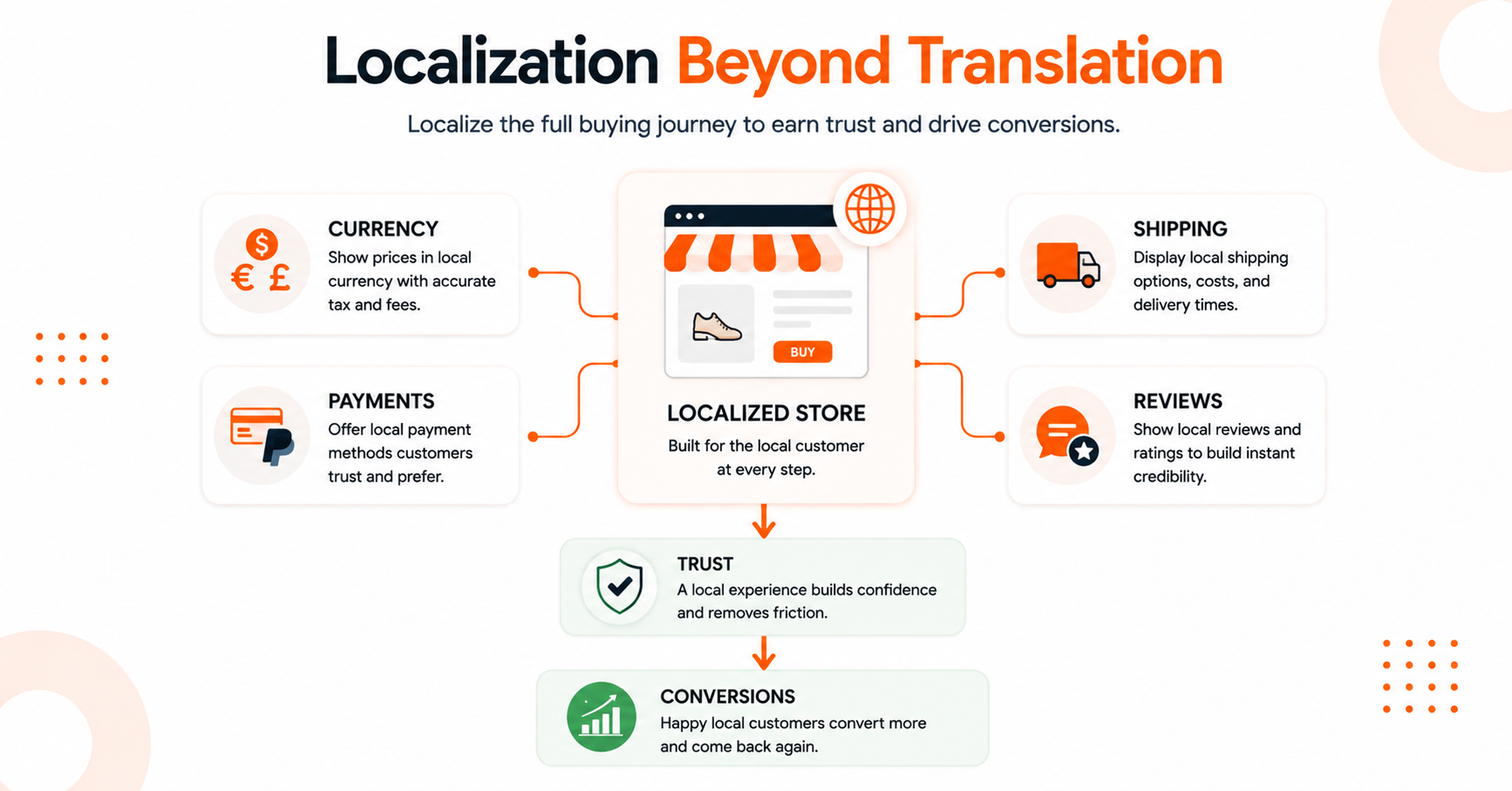
    International ecommerce localization strategy covering payments, shipping, reviews, and local currencies.

    Effective content localization means matching exactly how your target audience shops. Product page optimization must go far beyond simple translation to include:

    • Localized currency
    • Tax calculations
    • Metric measurements
    • Local payment badges
    • Region-specific shipping details

    These trust signals are essential for long-term conversion rate optimization. The point is simple: search can bring the click, but the on-site experience has to close the gap.

    Content needs the same treatment. Your category pages, product pages, FAQs, and support content should answer local questions in local language patterns.

    This is equally important for traditional rankings and emerging search technologies. When it comes to AI engine locale targeting, tools like Google AI Overviews, ChatGPT, and Perplexity prioritize pages that are clear, structured, and easy to interpret.

    If your localized page answers the question cleanly and in plain language, it has a much better shot at appearing in those answer layers.

    For DTC brands, this means building more than standard product pages. Consider investing in:

    • Buying guides
    • Localized return policies
    • Comparison content

    By using proper structured data across these pages, you also increase your chances of appearing prominently on the search engine results page and capturing more qualified traffic in every market you enter.

    Build Country-Level Authority and Track What Converts

    Search engines evaluate more than just your website code. They analyze whether your brand has established genuine relevance within a specific country.

    To achieve this, you must prioritize localized link building. Earn mentions, backlinks, and partnerships from sources native to your target market.

    This includes:

    • Securing placements in country-specific press
    • Collaborating with local creators
    • Partnering with regional distributors
    • Working with review sites

    Producing high-quality authority content that addresses local pain points is also essential for establishing your brand as a trusted resource. Furthermore, integrating user-generated content from local customers serves as powerful social proof that builds confidence with new audiences.

    Generic link volume is not the goal. Earning local trust is.

    Tracking your performance is equally critical. Global traffic metrics can often provide a false sense of success while local performance remains stagnant.

    To drive sustainable organic traffic growth, monitor these key metrics:

    • Organic traffic by market
    • Conversion rate by market
    • Revenue by market
    • Top landing pages
    • Branded search growth

    You can track this performance effectively by segmenting your data within Google Search Console. Additionally, ensure you set up Google Merchant Center with localized product feeds to improve your visibility in regional shopping results.

    Finally, do not ignore mobile performance. Since Google utilizes mobile-first indexing, your site must be optimized for the way local customers browse.

    A large portion of DTC buying happens on smartphones, often on unstable connections. If your localized store is slow, cluttered, or confusing on a mobile device, even the strongest SEO strategy will struggle to convert that traffic into sales.

    What Winning International SEO Looks Like

    The best international SEO setup for a DTC brand is boring in the best way. The right markets are chosen early, the site structure is clean, and localized pages feel native to every visitor.

    When search engines can easily understand your site and shoppers have a frictionless path to purchase, you create the foundation for a truly effective omnichannel retail strategy.

    Successful international expansion is about more than just rankings. By providing a localized experience that resonates with local preferences, you build trust and significantly improve customer lifetime value over time.

    Ultimately, this approach turns your global presence into a high-performing asset. A solid e-commerce SEO foundation is the key to sustainable organic traffic growth, allowing your brand to own its space in every market you enter.

    FAQs About International SEO for DTC

    Here are additional questions you might ask.

    Should DTC Brands Use a ccTLD for Every Country?

    No, DTC brands should not use a ccTLD for every country by default. While ccTLDs are a valid option, they often add unnecessary cost and complexity.

    Most brands achieve better results using subdirectories with geo-specific modifiers in the URL structure. This approach streamlines your technical SEO efforts and simplifies management.

    Unless you have large local teams, separate country operations, or a specific regulatory requirement to run each market independently, stick to a structure that allows you to manage hreflang tags more effectively across your site.

    Is Translation Enough for International SEO?

    No, translation is not enough for international SEO. Translation simply changes the words, but localization changes the entire user experience.

    To succeed in e-commerce SEO, you must prioritize both. This involves product page optimization that respects local currency and sizing, as well as conversion rate optimization to ensure your checkout process feels native.

    Ultimately, you need to establish local trust signals, such as regional payment methods and customer support, to turn visitors into buyers.

    How Many Markets Should a Brand Enter at Once?

    Usually, a brand should enter one to three markets at a time. Focusing on a small number of markets allows you to learn the nuances of each audience without spreading your team too thin.

    Expansion becomes significantly easier once you have proven your model in these initial markets. By mastering the local landscape in a few regions first, you gain the operational experience necessary to scale your international efforts efficiently.

    Does International SEO Help With AI Search Visibility Too?

    Yes, international SEO helps improve AI search visibility. Clear page structure, localized FAQs, and strong entity signals are essential for visibility in both traditional search and AI-driven results.

    The same content system that satisfies Google or Bing will also help you gain traction on regional search engines like Baidu or Naver. By providing direct, localized answers, you position your brand to appear in AI Overviews and answer engines, ensuring your products remain visible no matter how your customers choose to search.

    Ready to Win on International SEO for Your DTC Brand?

    International SEO success comes from making the right decisions early. When you prioritize the right markets, create localized experiences, and build a scalable technical foundation, you put your brand in a stronger position to grow across borders.

    Refresh is a digital growth agency that helps brands improve their visibility through SEO, content strategy, and organic growth initiatives.

    If you are preparing to enter new markets and want to build a stronger international SEO strategy, reach out to see how Refresh can help support your expansion goals.

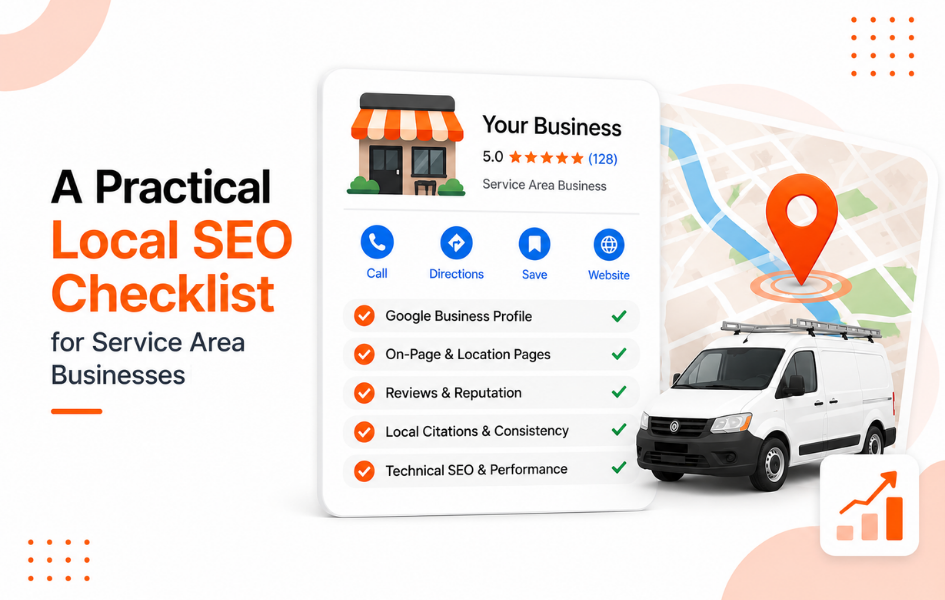
  • A Practical Local SEO Checklist for Service Area Businesses in 2026

    A Practical Local SEO Checklist for Service Area Businesses in 2026

    Paid ads can keep the phone ringing, but the lead flow often disappears when the budget stops.

    That is why a strong local SEO checklist matters for plumbers, HVAC companies, electricians, roofers, cleaners, locksmiths, landscapers, and other businesses that travel to their customers.

    In 2026, you are not only competing in the map pack. You are also competing in your Google Business Profile, local search results, AI Overviews, and the trust signals potential customers review before they ever call.

    Because customers searching for these services have high local intent, visibility at the exact moment they need help is critical for sustainable growth.

    Let's get your foundation right.

    Key Takeaways

    • Your Google Business Profile remains the most influential factor for local visibility. Proper category selection, detailed service setup, consistent hours, and an active review strategy are essential for success.
    • Your website must clearly demonstrate your service areas. Google will not rely on a simple map radius alone. You need concrete content that proves where you operate.
    • Online reviews serve a dual purpose. They help improve search performance while building the credibility needed to convince potential customers to call.
    • Service area businesses succeed when they make three elements obvious: where they work, what services they provide, and why local customers trust them.
    • In 2026, local SEO extends beyond traditional search and into AI-driven discovery. Clear answers, accurate business information, and strong reputation signals can improve visibility when users ask for recommendations.
    • This work compounds over time. A single optimized page, a well-managed profile, and a consistent review system can generate leads long after they are implemented.

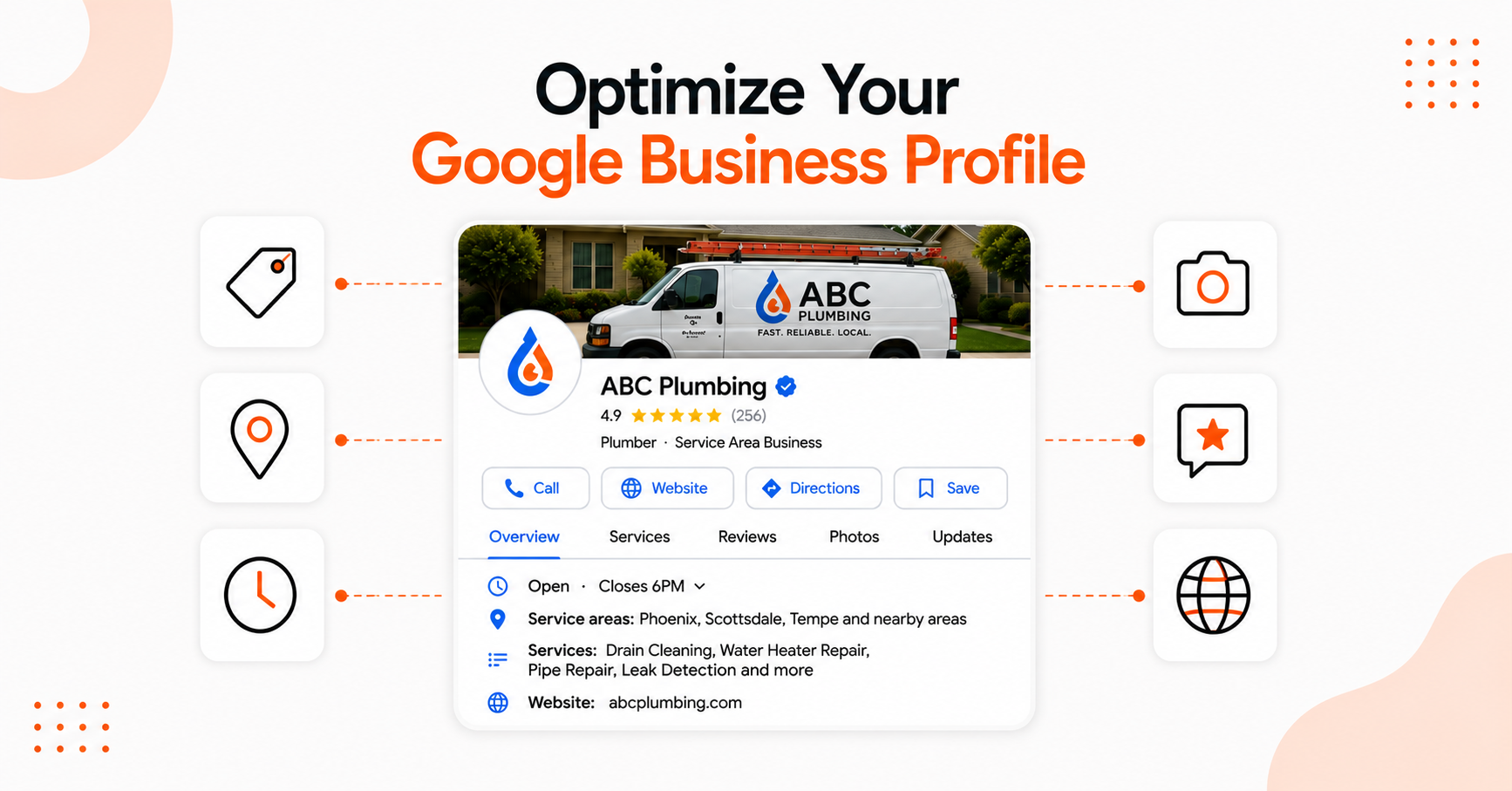
    Step 1: Your Local SEO Checklist for Google Business Profile

    For a service-area business, your Google Business Profile is often the first impression. Not your homepage or your quote form.

    By prioritizing your Google Business Profile, you ensure that potential customers see the right information immediately.

    Local SEO framework showing trust building, visibility, and lead generation.

    Choosing the Right Business Categories

    Start with the primary category. This is one of the biggest relevance signals you control.

    If you are a plumber, pick Plumber, not something broad like Contractor. Selecting accurate business categories is essential for ranking.

    Secondary business categories are helpful too, but only when they match the actual services you offer.

    Optimizing for Google Maps

    Fill out the entire profile to maximize your visibility on Google Maps.

    Complete every section of your profile, including:

    • Service areas
    • Service list
    • Business description
    • Hours and holiday hours
    • Phone number
    • Website
    • Booking link
    • Photos

    If customers do not visit your location, hide the address publicly and set the business up as a service-area business. You still need a real address for verification, but you do not need to broadcast it if you operate from home.

    Completing every field helps you rank higher in the map pack because Google rewards the most comprehensive listings.

    Photos matter more than a lot of owners think. Upload real job photos, team photos, vehicles, tools, and before-and-after shots. Stock images are easy to spot and do not build trust.

    Keep your presence active to maintain your rank on Google Maps. Add fresh photos, answer questions, and watch for user edits. A stale profile sends the wrong message, even if your business is solid.

    Finally, remember that online reviews belong inside this strategy. Incorporating consistent review management is like keeping the lights on in your storefront, ensuring that you convert profile views into actual customers.

    Step 2: Leveraging On-Page SEO and Location Pages

    Your Google Business Profile opens the door, but your website closes the deal.

    To capture qualified traffic, you must prioritize on-page SEO by creating a dedicated landing page for every core service you provide. Whether you specialize in drain cleaning, water heater repair, panel upgrades, AC installation, roof leak repair, house cleaning, or lawn maintenance, each offering deserves its own page.

    Do not bury six distinct services on one generic page and hope Google sorts it out. Instead, optimize these pages with relevant local keywords to help search engines understand exactly what you do and where you do it.

    Service Page Fundamentals

    A high-performing service page does not ramble.

    Every service page should clearly explain:

    • The service you provide
    • The problems you solve
    • Signs a customer needs help
    • What to expect during the process
    • How to get started

    To maximize impact, back up your content with local proof, client reviews, project photos, and FAQs.

    Using internal linking to connect these service pages to your location-specific case studies or testimonials reinforces your authority. It also helps customers navigate your site more effectively while signaling relevance to search engines.

    The Role of Location Pages

    Now let us address the strategy for location pages because this is where many businesses go off the rails.

    You do not need 80 thin pages with identical copy and a different city name pasted into the headers. That approach is outdated, lazy, and easy for search algorithms to identify as spam.

    You should only create location pages for the areas that matter most, provided you can make them authentic.

    Authentic location pages often include:

    • Specific neighborhood names
    • Common local home types
    • Seasonal maintenance issues
    • Regional permit quirks
    • Local storm patterns
    • Travel times
    • Area-specific job examples
    • Local testimonials

    If you cannot provide real job examples or testimonials specific to that area, it is better to skip the page entirely.

    The core objective is to provide Google with evidence that your business is deeply rooted in a specific place, rather than simply claiming you serve all nearby cities.

    By focusing your location pages on genuine geographic relevance and using local keywords naturally throughout the text, you build assets that continue to perform over time.

    If you are building a larger visibility system and want to think beyond one-off tweaks, the logic behind hiring an organic growth agency is the same here: build assets that keep working instead of renting every visit forever.

    Step 3: Make Reviews and Social Proof Part of the Job

    This is one of the most important part you should never forget.

    Build a Proactive Review Strategy

    A lot of local businesses treat online reviews like dessert. They think it is nice if it happens but not essential.

    This is a mistake, as online reviews are actually part of the main meal.

    The best strategy is simple:

    • Ask every happy customer
    • Ask them quickly
    • Make the process easy

    The sweet spot is right after the job is complete and the customer feels the result of your work.

    Send a short text or email with the review link. Keep the request human and avoid scripts that sound like a robot wrote them.

    What matters in 2026 is not just the total volume of feedback.

    The factors that matter most include:

    • Recency
    • Frequency
    • Relevance

    A steady stream of honest feedback helps improve your local rankings, which is far more effective than one big burst of reviews followed by six quiet months.

    When possible, encourage customers to provide useful details. A review that mentions the specific service, the city, the speed, or the quality of the technician gives both Google and future buyers more context.

    This added clarity helps Google understand your business better, which can improve your position in local search results. Do not coach people into weird keyword stuffing, but simply ask for an honest description of what was done.

    You must reply to every review.

    Thank the customer and mention the service naturally. When handling negative feedback, stay professional because potential customers are reading your responses.

    Incorporating consistent review management into your daily workflow shows that you value your clients and stand behind your work.

    Showcasing Social Proof

    Take that proof beyond your Google profile.

    Strong trust signals include:

    • Customer reviews
    • Licenses
    • Insurance details
    • Certifications
    • Warranty information
    • Team bios
    • Project photos
    • Local partnerships
    • Trade association memberships

    If you sponsor a local team, belong to a trade association, or work with recognizable builders or property managers, showcase that information as well.

    This is also where video starts pulling its weight.

    A 30-second job walkthrough, a quick explanation of what happened on-site, or a before-and-after clip can do more than a long paragraph of generic sales copy. It builds trust quickly and gives you versatile content for your website, YouTube, and social media channels at the same time.

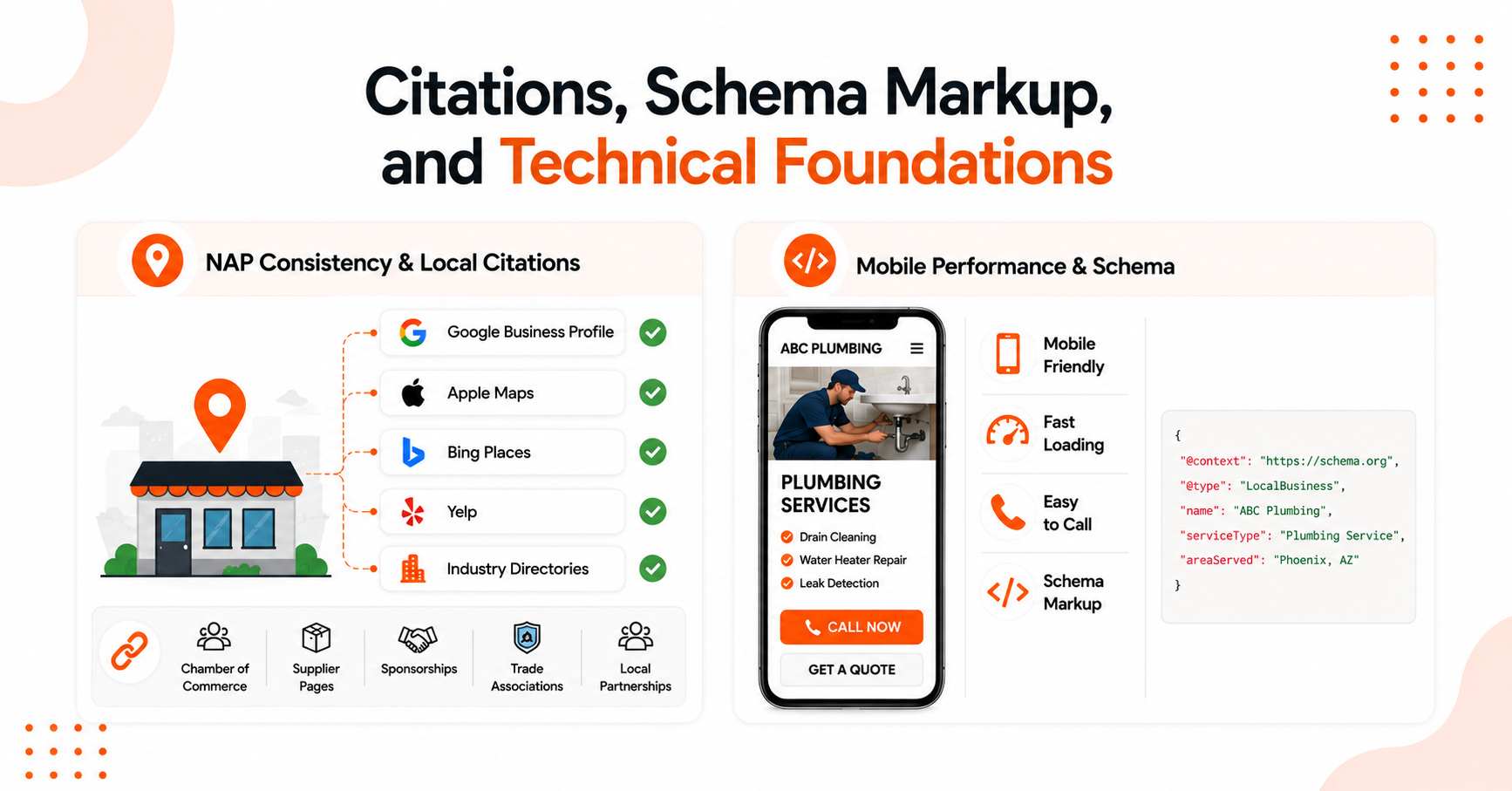
    Step 4: Citations, Schema Markup, and Technical Foundations

    Most local campaigns do not fail because of one dramatic mistake.

    They lose because of sloppiness. If you want to rank effectively, you must eliminate the digital friction that confuses both users and search engines.

    Local SEO foundations including citations, schema markup, and mobile optimization.

    NAP Consistency and Local Citations

    Start by conducting a thorough citation audit to identify errors in your business information.

    Your business name, phone number, and address need to reflect perfect NAP consistency across the web.

    Prioritize consistency across:

    • Google Business Profile
    • Apple Maps
    • Bing Places
    • Yelp
    • Industry-specific business directories

    This uniformity is vital because duplicate listings can confuse search engines and dilute your authority.

    When managing your local citations, prioritize accuracy above all else.

    Beyond major platforms, look for opportunities to build local backlinks through:

    • Chamber of commerce listings
    • Supplier pages
    • Sponsorships
    • Trade associations
    • Local partnerships

    These links serve as powerful signals that confirm your business is active within your specific market.

    Remember that building local citations is a long-term commitment to quality. Periodically check your listings in major business directories to ensure your details remain accurate as you grow.

    Mobile Performance and Schema

    Your website must function flawlessly on every device.

    A mobile-friendly website is no longer optional. It is the baseline requirement for modern service providers.

    Ensure that your page loading speed is optimized to meet Core Web Vitals. Also make sure that critical elements like your phone number and inquiry forms are easily accessible.

    To help search engines understand your location and service offerings, you must implement proper schema markup.

    By adding LocalBusiness schema and relevant service markup to your site, you provide the structured data that helps algorithms connect your services to your specific geographic reach.

    While this schema markup is not a replacement for high-quality content, it acts as an essential technical foundation. It helps search engines and AI systems better understand your business information and service areas.

    If you want a fast gut check, ask yourself this:

    Can a stressed homeowner on a cracked phone screen figure out what you do, where you work, and how to call in under ten seconds?

    If not, fix that first.

    Prepare for AI Overviews and Answer Engines

    Search habits have evolved.

    While people still rely on Google, they are increasingly asking full questions and expecting immediate, accurate answers.

    This shift impacts service-area businesses more than many realize.

    A customer might perform a traditional search for an emergency electrician, but they are just as likely to ask ChatGPT, Perplexity, or Google AI Overviews which company installs EV chargers in their neighborhood, who repairs tankless water heaters, or how much drain cleaning typically costs.

    Because of this, your strategy must pivot to address the local intent behind these conversational queries.

    Put direct answers high on the page.

    A few best practices include:

    • Use question-based subheadings
    • Add short FAQ sections
    • Include pricing ranges when appropriate
    • Explain timelines and permits
    • Highlight warranties
    • Clarify emergency availability

    By implementing structured data, you help AI models parse your business information more effectively. This ensures your site provides the precise data required to appear in local search results while supporting AI-driven discovery.

    Entity consistency remains vital.

    When your business details, reviews, services, and reputation signals align across your site and the wider web, answer engines can better verify your proximity relevance and prominence.

    Recent industry standards on AI-driven local search visibility consistently show that clear, data-backed information outperforms vague marketing copy.

    Video is another powerful tool for this shift.

    YouTube is a massive search engine, and local service questions appear there daily.

    A short video explaining how to identify a failed AC capacitor or determine if a roof leak is an emergency can rank independently, support your service pages, and provide a rich media asset that AI can process and trust.

    This is the most significant change for 2026.

    Your future customers are not just searching. They are asking.

    The businesses that win will be the ones that consistently show up with the clearest, most reliable answers.

    Track Results and Follow a Monthly SEO Rhythm

    A checklist is useless if it sits in a document and nobody touches it again.

    Track what happens after the impression.

    The metrics that matter most include:

    • Profile calls
    • Direction requests
    • Site clicks
    • Form fills
    • Booked jobs
    • Closed revenue by service type

    While monitoring your Google Search Console performance is essential, remember that rankings are nice, but jobs are better.

    How Long Does Local SEO Take to See Results?

    Local SEO is a marathon, not a sprint.

    While you might notice quick wins after implementing technical fixes, building true authority and climbing local rankings usually takes 3 to 6 months.

    Consistency is key, especially when you are working to earn local backlinks that signal trust to search engines.

    Use Google Search Console to monitor your progress during these initial months, as it provides the data necessary to refine your strategy.

    Keep a simple monthly rhythm:

    • Review your Google Business Profile, update hours, and upload fresh job photos.
    • Ask for reviews, respond to new ones, and look for patterns in what customers keep praising.
    • Improve or publish one high-value page and optimize its title tags and meta descriptions.
    • Perform a technical SEO audit and check your Core Web Vitals to minimize mobile friction.
    • Refine content to better match user intent in your specific service areas.

    If you want a quick outside worksheet to compare your setup against, Local SEO Checklist is a solid reference.

    And if this has gone past weekend project territory, that is normal.

    Once local SEO expands into content, technical fixes, reviews, AI visibility, and video, it becomes real operating work.

    FAQs About Local SEO Checklist

    Here are additional questions you might ask.

    Do Service-Area Businesses Need to Show an Address on Google Business Profile?

    No. If customers do not visit your location, you can hide the address and set service areas instead.

    You still need a real address for setup and verification of your Google Business Profile, but it does not have to be public if you are a mobile or home-based operation.

    What Is the Fastest Local SEO Win for Most Service Businesses?

    Cleaning up your presence on Google Maps and implementing a consistent review system are essential. Those two moves often create the fastest lift because they improve both visibility and conversion at the same time.

    Do Reviews Help Rankings or Only Conversions?

    Both. Generating positive online reviews can support your local rankings, and they absolutely help people choose you over a competitor. Fresh, detailed feedback is much more valuable than a giant pile of outdated entries.

    Your Next Customer Is Already Searching

    The businesses that win in 2026 are not always the biggest. They are the ones that make it easy for customers and search engines to understand who they are, what they do, and where they work.

    Get your Google Business Profile right, build pages that prove your services and service areas, keep reviews coming, and consistently answer the questions your customers are already asking. Over time, those efforts compound into more visibility, more calls, and more booked jobs.

    Refresh helps businesses grow through SEO, content, and organic visibility strategies designed to create long-term results. If you are ready to strengthen your local search presence, book a call with us and discover where your biggest opportunities may be!

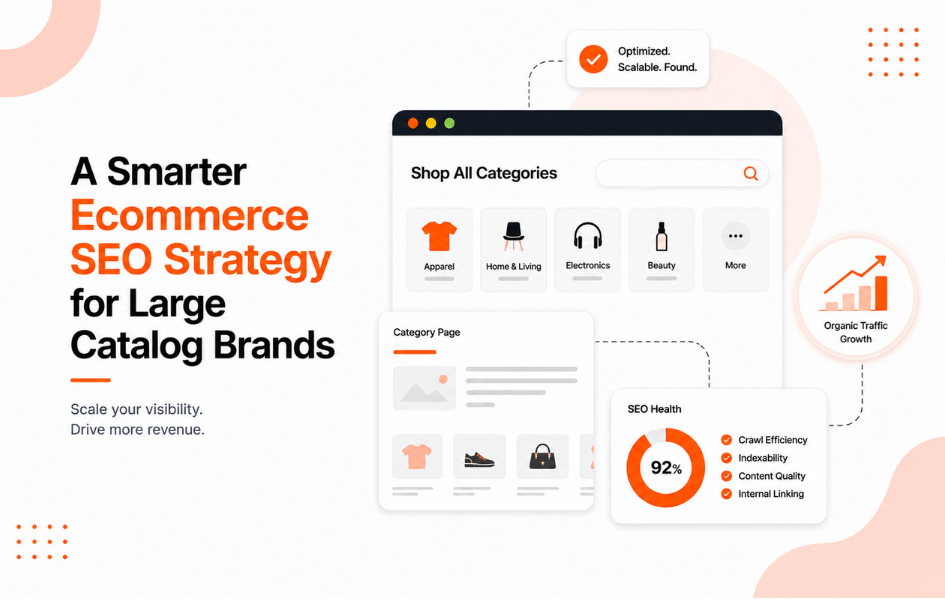
  • A Smarter Ecommerce SEO Strategy for Large Catalog Brands

    A Smarter Ecommerce SEO Strategy for Large Catalog Brands

    A large product catalog can make your store look robust and authoritative while still leaving it virtually invisible to potential customers.

    When thousands of URLs pile up, search engines do not automatically see an opportunity for growth. Instead, they often encounter duplication, wasted crawl budget, and mixed signals that prevent your site from capturing the organic traffic it deserves.

    That is why a serious ecommerce SEO strategy for a large catalog must be built on scalable systems rather than one-off page edits.

    Key Takeaways

    • Large catalogs win when category pages act as the foundation for your overall ecommerce SEO strategy.
    • Mastering technical SEO is just as critical as on-page optimization for managing expansive product databases.
    • Strong, scalable templates produce more consistent results than relying on random manual fixes.
    • Not every filter, product variant, or low-value page deserves to be indexed by search engines.
    • Long-term success requires alignment between your content efforts and the specific search intent of your customers.
    • The most effective SEO programs prioritize resources based on potential revenue rather than total URL count.

    Start With Architecture, Not More Pages

    Most large ecommerce sites do not have a content problem. They have a site architecture problem.

    Your category pages should function like commercial landing pages, crafted around rigorous keyword research to ensure they meet user intent. They need a clear purpose, clean URLs, strong internal links, and copy that helps shoppers narrow the field. If those pages are thin, buried, or cannibalized by filter URLs, rankings stall fast.

    Every product should sit inside a simple hierarchy. No weird detours. No five different paths to the same item. Search engines still use site structure as a major clue, and shoppers do too.

    That means fewer orphan pages, fewer internal dead ends, and more effective internal linking that pushes authority into the pages that can actually rank. A clean architecture also makes future growth easier. Add a new collection, brand, or season, and the site still makes sense.

    Here is the simple test: if a new team member cannot explain your category structure in two minutes, it is probably too messy.

    Protect Crawl Budget and Control Duplicate URLs

    This is where large catalogs go sideways, and where sound technical SEO becomes a necessity.

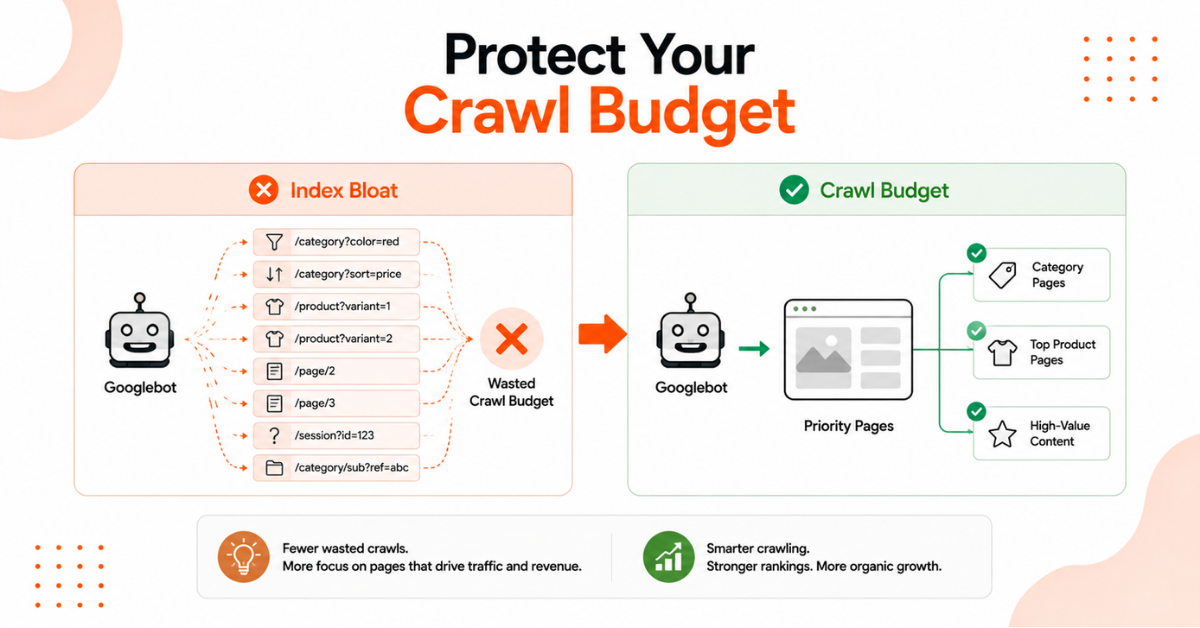
    Filters, sort orders, color variants, pagination, session parameters, and duplicate category paths can turn one product into a pile of near-identical URLs.

    Technical SEO diagram showing how crawl budget optimization improves indexing of priority pages.

    Common causes of index bloat include:

    • Filter combinations
    • Sort-order URLs
    • Product variants
    • Pagination issues
    • Session parameters
    • Duplicate category paths

    Search engines waste time on these variations, which means your priority pages receive less attention. If you allow this index bloat to continue, you will inevitably experience a drop in organic traffic.

    Large-catalog SEO is a prioritization problem first, and an optimization problem second.

    Use canonical tags where duplicate versions need to exist. Use noindex directives when a page helps users navigate your site but should not compete in search results.

    Keep faceted navigation indexable only when the filtered result matches real user demand and maintains enough stable inventory to deserve a dedicated landing page.

    Split your XML sitemap by page type to improve crawl efficiency. Monitor your performance in Google Search Console, and if you have the resources, review your server logs.

    You want search bots spending their time on your money pages, not on junk URL combinations.

    That matches the thinking in these scalable enterprise ecommerce SEO tactics. The big idea is simple: treat scale like a systems challenge, not a page-by-page checklist.

    Build Templates That Scale Without Feeling Thin

    You do not need handcrafted copy for 80,000 SKUs. You do need a strong template.

    Product Page Templates

    For product pages, that means moving beyond basic specs to create high-quality product descriptions.

    A scalable template should consistently include:

    • Optimized title tags
    • Meta descriptions
    • Image alt text
    • Schema markup
    • Structured data

    When possible, add differentiators buyers care about, such as sizing guidance, compatibility notes, materials, care instructions, or shipping details.

    Beyond text, remember that your pages must remain mobile-friendly and meet Core Web Vitals standards to ensure a seamless experience.

    Category Page Templates

    Category pages need templates too.

    Give them room for:

    • A short introduction
    • Featured brands
    • Common use cases
    • Internal links to top subcategories
    • Supporting FAQ content

    By incorporating user-generated content like customer reviews, you add social proof that helps both rankings and conversions.

    Furthermore, syncing your product data with Google Merchant Center is essential to maximize your visibility across search surfaces.

    Prepare for AI-Driven Search

    This is also where 2026 search looks different.

    Google's AI Overviews and answer engines pull directly from trustworthy, structured data. If your pages are vague or missing key attributes, they get skipped.

    Brands that win long-term do not just rank individual pages. They show up where customers ask questions and get instant answers.

    A solid template turns SEO into an asset. Paid traffic stops when the budget runs out, but a well-built catalog continues to drive results long after the work is done.

    For a broader look at how that plays out in online retail, this guide on how SEO affects ecommerce growth is worth a read.

    Prioritize by Revenue, Not by URL Count

    Now the strategic part.

    Not every page deserves the same effort. If your team treats a low-margin product and a top category the same way, you will stay busy and move slowly.

    That is not a growth plan. That is churn.

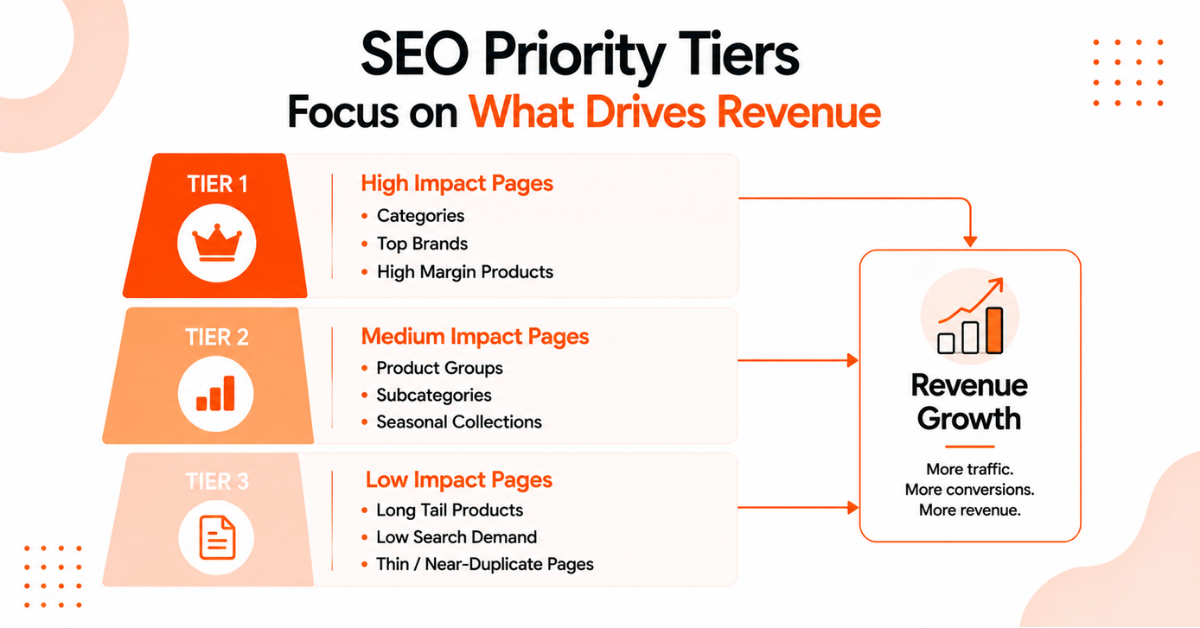
    Create SEO Priority Tiers

    Start by tiering your site.

    SEO priority framework showing high, medium, and low impact pages based on revenue potential.

    Tier 1 pages typically include:

    • Core category pages
    • Top brands
    • Highest-margin products
    • High-intent informational pages

    These Tier 1 pages should be carefully aligned with search intent and high-volume keywords identified during your keyword research.

    Because these pages are vital for your bottom line, they require a dedicated link building strategy to earn high-quality backlinks that boost authority and improve your store conversion rate.

    Lower-value pages can rely more on templates and rules.

    Align SEO With Merchandising

    Merchandising and SEO need to stay tied together here.

    If a product is seasonally out of stock, keep the page live when demand will return. If it is gone for good, redirect it to the closest replacement or category page.

    Do not leave dead ends everywhere and call it site maintenance.

    The brands pulling ahead are not always spending more. They are building a stronger organic engine, one that compounds over time and keeps showing up across search and AI-driven results.

    FAQs About Ecommerce SEO Strategy

    Below are additional questions that might help you.

    How Many Product Pages Need Unique Copy?

    Usually not all of them.

    Prioritize writing custom copy for high-demand, high-margin, or hard-to-differentiate product pages first. For the rest of your catalog, use better templates, richer data fields, reviews, and structured markup.

    This approach allows you to scale efficiently while still targeting specific long-tail keywords that drive qualified traffic to your site.

    Should Filter Pages Be Indexed?

    You should only index filter pages when the resulting view matches verified search demand and remains useful for users over time.

    Deciding which pages to include in the index should be a core component of your ongoing SEO audit. Most filter combinations should remain excluded from search results so they do not crowd out your primary category pages or dilute your site authority.

    What Should You Measure First?

    Start by tracking non-brand organic revenue, category page visibility, and indexation quality.

    You should also use keyword research to monitor SERP performance for specific title tags and meta descriptions across your highest-value page groups.

    While rankings are a useful signal, tracking revenue by template type provides the clearest indication of whether your strategy is delivering a tangible return on investment.

    Ready to Build a Stronger Ecommerce SEO Strategy?

    A massive catalog is not an SEO advantage by default. It is raw material.

    The brands that win turn that sprawl into structure, crawl rules, strong templates, and ruthless prioritization. By organizing your catalog effectively, you position your brand to dominate the SERP and capture high-intent searchers.

    Do that well, and organic growth starts to compound, providing a sustainable source of organic traffic that does not reset every month like paid advertising campaigns.

    Refresh helps brands turn complex catalogs into scalable SEO systems. If that sounds like the challenge you are facing, schedule a call to explore your next steps.

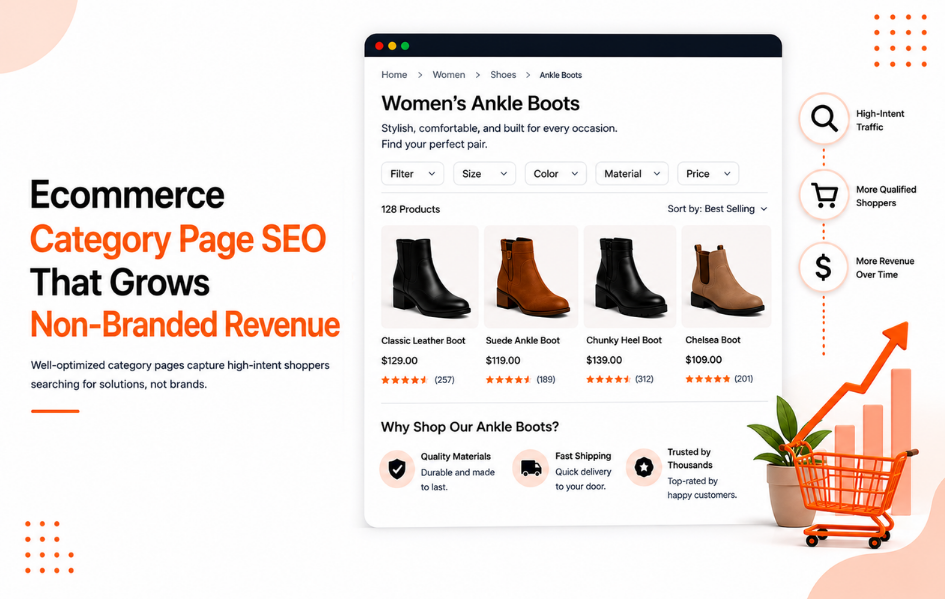
  • Ecommerce Category Page SEO That Grows Non-Branded Revenue

    Ecommerce Category Page SEO That Grows Non-Branded Revenue

    If your category pages only rank for your brand name, you are capping your upside and limiting the flow of high-quality organic traffic to your site.

    The real revenue growth comes from generic searches. These are the queries shoppers use when they are exploring options but have not yet identified their preferred brand.

    This is why effective ecommerce category page SEO matters so much. When you optimize these pages to align with specific search intent, they do more than pull in raw traffic. They attract buyers who are ready to make an informed decision.

    Let's explore the strategies that make these pages work for your business.

    Key Takeaways

    • Category and collection pages are often the most effective assets for capturing high-intent, non-branded search traffic.
    • Your site hierarchy should be aligned with actual search demand rather than internal organizational naming conventions.
    • Thin pages rarely rank. High-performing pages must improve the user experience by helping shoppers compare products, apply filters, and move confidently toward a purchase.
    • Technical optimization is critical for ecommerce sites, particularly when managing faceted navigation and preventing index bloat from duplicate content.
    • Top-ranking category pages compound in value over time, which is why organic growth remains a more sustainable strategy than paying for every click through advertisements.

    Why Category Pages Drive Non-Branded Revenue

    A product page is usually too narrow for broad commercial searches. A blog post can bring awareness, but it often sits one step too early in the customer journey.

    Category pages hit the sweet spot because they align perfectly with user search intent.

    They match how people shop. Someone searching for women's black ankle boots is not looking for a brand story; they are looking for options, filters, pricing, and a fast path to the right product.

    Because these pages allow you to target specific long-tail keywords, they capture high-intent shoppers who are ready to buy.

    This is also why these pages can become serious growth assets.

    Paid search is a faucet. Turn it on, traffic shows up. Turn it off, traffic disappears. A well-ranked category page is different.

    As these pages accumulate pagerank over time, they keep working, keep earning clicks, and keep driving revenue long after the initial work is done.

    Paid traffic rents attention. Strong category pages build an asset.

    If you want a second opinion on their importance, Digital Commerce's category-page analysis makes the same point in plain terms. These are often the highest-leverage pages on the site.

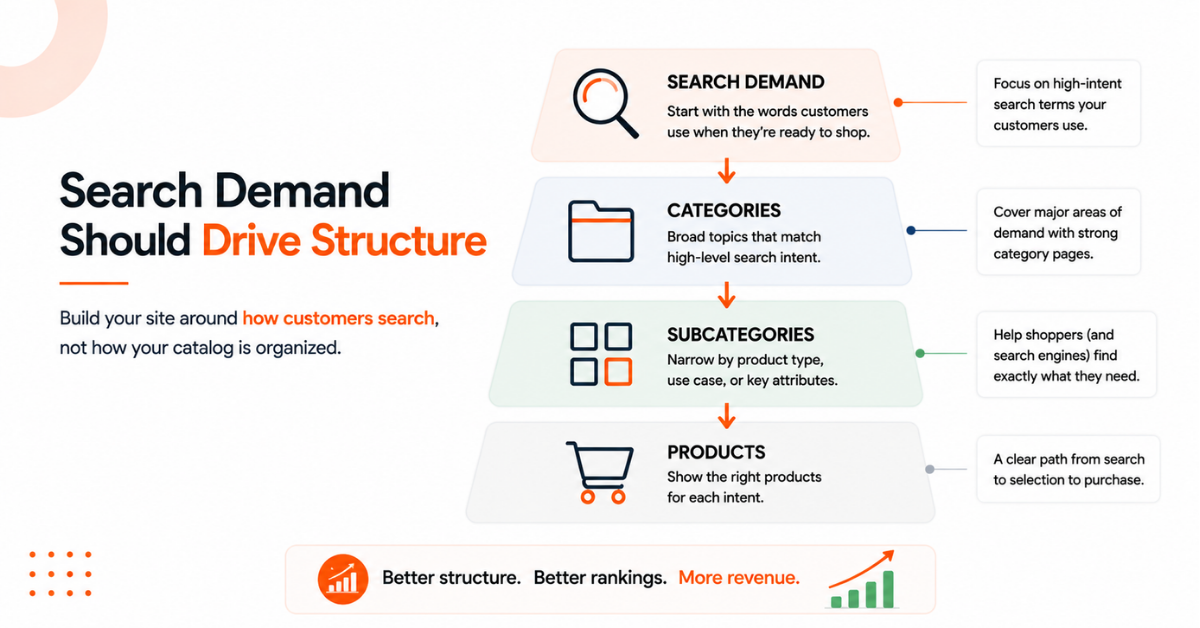
    Start With Search Demand, Not Your Catalog

    Here is where a lot of ecommerce teams go wrong.

    They build category pages around internal naming, supplier language, or whatever sounded organized in a spreadsheet. Google does not care about your spreadsheet. Your customers do not either.

    SEO site structure framework showing search demand, categories, subcategories, and products aligned with user intent.

    Start with the phrases people use when they are ready to shop. Focus on high-intent long-tail keywords rather than internal jargon.

    For example:

    • "ceramic planters," not "home styling vessels"
    • "men's trail running shoes," not "outdoor performance footwear"

    If the page name does not line up with search demand, you are making ranking harder than it needs to be.

    Then map that demand to the right page type.

    One core query cluster should have one clear primary page. Do not let a blog post, a product listing page variation, and three filter URLs fight over the same term.

    That is how sites suffer from keyword cannibalization and stall out in the rankings.

    Your site hierarchy matters, too.

    Parent categories should target broader demand, while subcategories should narrow the focus by product type, use case, or a meaningful attribute. These subcategories help users, search engines, and increasingly AI systems that summarize shopping options.

    One more thing: faceted navigation can wreck this fast.

    If every filter creates a crawlable page, you get bloated indexation and a messy URL structure that wastes your crawl budget. Keep only high-value filtered pages indexable.

    The rest should consolidate back to the main category page.

    Build Pages That Help People Choose

    A ranking page that does not convert is a vanity project. You want to prioritize both SEO and conversion rate optimization to see real results.

    That starts with the technical basics. This means optimizing your title tags and H1 tags for relevance, placing helpful introductory copy near the top of the page, and establishing clear internal context through breadcrumbs.

    These breadcrumbs help both users and search engines navigate your site architecture effectively. For a practical look at those foundational elements, Uproer's category page checklist is a solid reference.

    But the bigger win is this: make the page useful enough that shoppers stay. Design a product grid that aligns with how your customers shop. Surface key product differences, stock levels, pricing, and social proof like star ratings or reviews.

    Add short, supporting copy lower on the page that answers real buying questions rather than fluffy filler written to appease a search engine.

    Good category copy does three jobs at once. It tells search engines what the page covers, gives AI answer systems better context, and helps humans choose products faster. Ultimately, this approach improves the overall user experience.

    Your content should sound like a smart sales associate, not a keyword soup disaster. Talk about materials, fit, sizing, use cases, compatibility, or common tradeoffs.

    If people repeatedly compare lightweight versus durable options or beginner versus pro models, provide that guidance directly on the page.

    Technical quality is also critical. Prioritizing mobile responsiveness and fast page load speed is non-negotiable. Additionally, ensure you manage canonical URLs correctly and implement schema markup or structured data to help search engines display rich snippets in the results.

    These elements all support the main goal: make the category page the obvious result for the query and the easiest path to purchase once someone lands there.

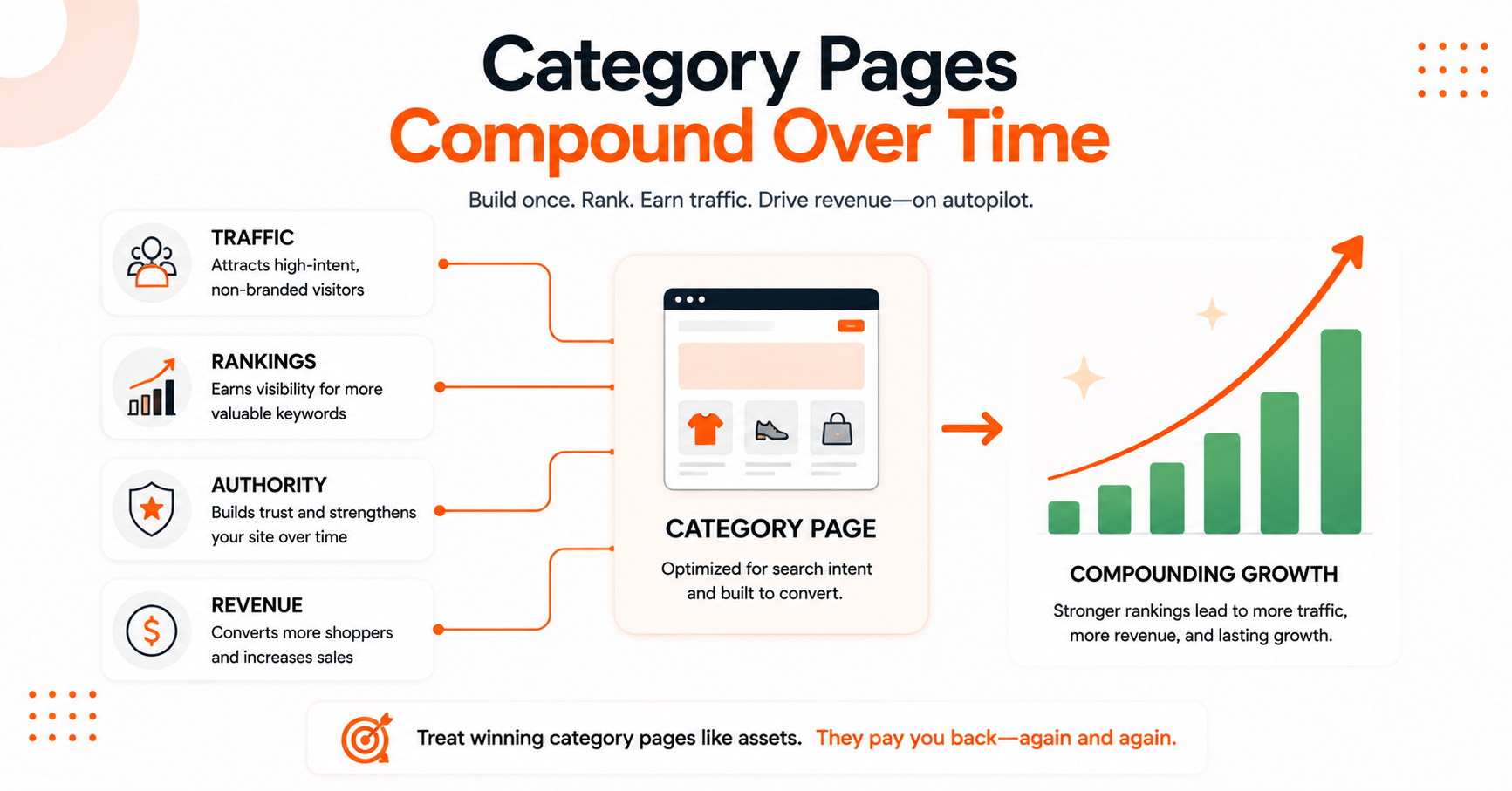
    Treat Winning Pages Like Growth Assets

    The first version of a category page is rarely the final version, and that is perfectly fine. The teams that win keep improving the pages that already show signs of life.

    SEO category page strategy showing how rankings, traffic, authority, and revenue compound over time.

    Watch non-branded impressions, clicks, category-level revenue, and assisted conversions. If a page is stuck on page two, small upgrades can move the needle fast. Tighten the copy, improve the product mix to better serve the user experience, and expand the FAQ section.

    Strategic internal linking from related collections and helpful guides can also provide a significant boost. Furthermore, testing stronger titles and meta descriptions can help improve your click-through rates. By prioritizing smart internal linking, you ensure that search engines and visitors can easily navigate between your most valuable assets.

    This is long-game work, and that is the point. Every improvement stacks. Every stronger page increases your visibility, your authority, and your margin on future traffic.

    FAQs About Ecommerce Category Page SEO

    Here are additional questions you may be curious about.

    How Much Text Should a Category Page Have?

    Include enough text to add context and help someone make an informed purchase.

    For most pages, that means a short, sharp piece of introductory copy near the top, followed by more helpful content lower on the page. You should avoid crowding the user experience by placing 800 words above your product grid.

    Should Filtered Category Pages Be Indexed?

    Only index these pages when there is real search demand and the page can stand on its own.

    While faceted navigation can lead to thousands of URLs, you should only index those that target valuable queries. If a filtered page lacks sufficient unique content, it is better to fold those signals back into the main category page or relevant subcategories to avoid diluting your site wide pagerank.

    Always ensure your URL structure remains clean and easy for crawlers to navigate.

    Can Category Pages Outrank Product Pages for Generic Searches?

    Yes, and they usually should.

    Broad commercial queries often align better with category search intent than the specific focus of a single product page. By leveraging internal linking, you can signal to search engines that your category pages are the authority hubs for these broad terms.

    You should reserve your product pages for specific model, SKU, or product name searches, while letting your category pages do the heavy lifting for generic industry terms.

    Your Next Sale Might Start on a Category Page

    Non-branded growth usually does not come from a clever homepage or another ad campaign. It comes from category pages that align with user search intent and make it easy for shoppers to find the right products.

    When you prioritize ecommerce category page SEO, those pages become long-term assets that continue driving organic traffic and revenue over time.

    If you want help building that kind of growth engine, book a call with Refresh and explore where your biggest opportunities may be.

  • YouTube SEO for SaaS That Converts Viewers Into Customers

    YouTube SEO for SaaS That Converts Viewers Into Customers

    Most SaaS teams treat YouTube SEO for SaaS like a side project. A few product demos are uploaded, perhaps a webinar replay, and then the channel sits there collecting dust.

    Without a deliberate strategy, you gain no organic traffic, no pipeline, and no real return on investment. That is a missed opportunity.

    A well-executed video strategy works when each piece of content answers a real buyer question, earns the click, keeps attention, and moves viewers one step closer to a trial or demo.

    When your video content aligns with broader B2B SaaS marketing goals, it stops being a nice-to-have and starts acting as a reliable engine for pipeline and revenue.

    Key Takeaways

    • YouTube delivers the best results when a single video solves one specific problem for a well-defined audience by precisely matching their search intent.
    • Prioritize high click-through rates and viewer retention rather than trying to stuff extra keywords into your video titles or tags.
    • Creating short, focused product tutorials often helps your content rank in search results much faster than broad or abstract brand videos.
    • Consistent YouTube content compounds in value over time, which is exactly why it is a more effective strategy than relying on one-and-done promotional tactics.

    Why YouTube SEO for SaaS Matters More Than Most SaaS Teams Think

    Your buyers no longer conduct research in a single location. They bounce between Google, the YouTube search engine, AI tools, review sites, and your homepage. If your company is not visible in those moments, you are not in the conversation.

    This is why implementing a comprehensive SaaS SEO strategy has become a critical component of modern growth. YouTube acts as one of the largest search platforms available, and it is built specifically for intent.

    When a user searches for solutions or identifies software for their team, they are not browsing for entertainment. They are conducting deep customer research to solve a problem immediately.

    By creating educational content that addresses the specific jobs to be done for your ideal customer profile, you can provide the exact answers your prospects are looking for.

    This makes video a strong fit for product-led growth, demand generation, and category education. A well-optimized video can rank in YouTube search, appear in Google results, and build trust faster than a standard blog post.

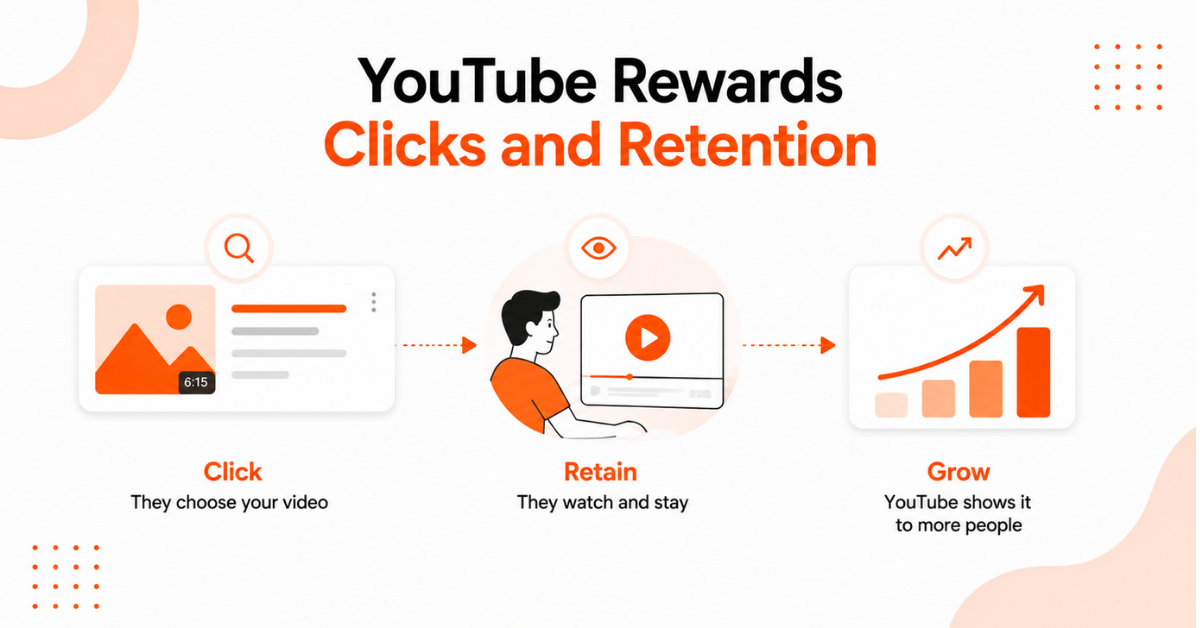
    YouTube rewards clicks and retention illustration flow.

    Furthermore, it drives consistent organic traffic back to your site. While paid ads create a temporary spike in interest, the flow of visitors stops the moment the budget runs out.

    Helpful videos do not work that way, as they continue to get discovered over time.

    A smart SaaS video strategy also supports the rest of your organic visibility. It provides your brand with more surface area when prospects compare tools, research pain points, or sanity check your credibility before booking a demo.

    By funneling viewers toward your high-converting landing pages and comparison pages, you improve your ability to build brand awareness while guiding users toward a purchase.

    The goal is not views for vanity. It is qualified attention that turns into trust, traffic, and signups.

    How YouTube Actually Decides Which SaaS Videos to Surface

    Here is the simple version. YouTube wants to keep people watching.

    So it tests your video with small groups first. If people click and stay, it gets shown to more people. If they bounce, distribution slows down.

    That means your biggest ranking factors are not mysterious. They are packaging and satisfaction.

    Your title and thumbnail create the promise. The opening 15 to 30 seconds either confirms that promise or breaks it.

    If the content gets to the point fast, retention improves. If it rambles, you are done.

    Refining your video metadata remains essential, of course. Utilizing tools like TubeBuddy, vidIQ, or SEMrush for keyword research helps you craft titles, descriptions, and tags that allow YouTube to accurately categorize your content.

    However, metadata cannot rescue a weak video. That is consistent with both industry standards and what strong B2B creators see in practice: videos often start by ranking for a narrow search, then grow into Suggested once watch signals improve.

    For SaaS in 2026, that usually means a few things:

    • Shorter videos often work well for direct questions and feature-level product tutorials.
    • Shorts help with discovery, especially at the top of the funnel.
    • Narrow topics beat generic thought leadership almost every time, as these specific solutions are perfect for reaching prospects at the bottom of the funnel.
    • The evolution of LLMs and ai search is changing how users discover content, placing even more importance on clear, intent-driven video topics.

    So yes, optimize the metadata. But build the video for the viewer first.

    That is the part that wins.

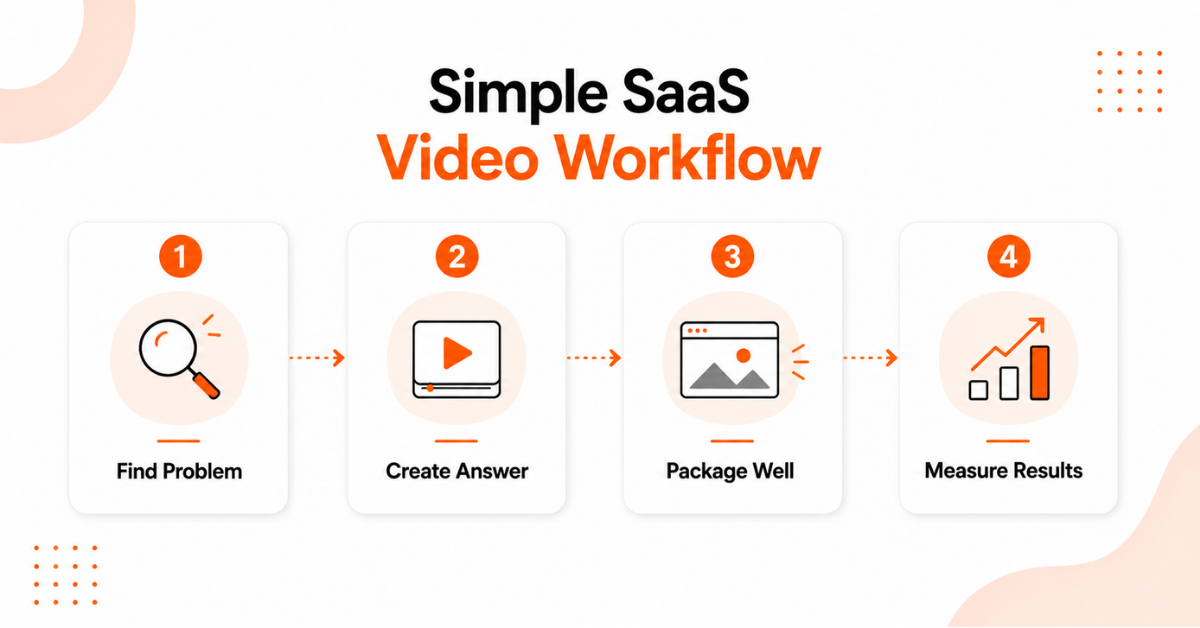
    A Practical YouTube SEO Workflow for SaaS Teams

    Most teams do not need more content. They need a better system.

    Simple YouTube SaaS video workflow illustration.

    Start with this, as it is foundational to a successful SaaS SEO strategy:

    1. Pick One Painful Problem Per Video

    Stop aiming for broad topics and start targeting high-value money keywords that align with clear search intent.

    Instead of generic titles, focus on specific pain points like "How to Stop Lead Follow-Up From Slipping Through the Cracks." This clarity helps your content rank for the exact problems your prospects are searching for right now as part of your broader SaaS SEO strategy.

    2. Match the Format to the Query

    Different searches require different approaches. How to queries need tutorials, but bottom of the funnel users often look for product comparisons, competitor alternatives, or dedicated comparison pages.

    By creating high-quality comparison pages and identifying the best competitor alternatives for your niche, you ensure your video format aligns with the stage of the funnel. Additionally, embedding these videos on your landing pages ensures you are capturing users who are ready to make a buying decision.

    3. Hook Hard, Then Move

    Do not spend 40 seconds introducing the company. Open with the problem, the result, or the mistake.

    Then show the answer immediately. Fast pacing is essential because viewer retention directly impacts your rankings in YouTube search and visibility in LLMs and AI search.

    4. Package the Video Like You Mean It

    Write a clear title and create a thumbnail centered on a single core idea. Add chapters, accurate captions, and a description that includes your feature, use case, and a clear next step.

    Integrate social proof to build trust and validate your authority. If the video deserves traffic, package it to maximize lead generation.

    Conduct a regular content audit to identify gaps in your existing library. Repurpose your core videos by turning them into Shorts, embedding them in relevant pages, and using them as a source for link building.

    When other sites embed your helpful tutorials, you generate valuable backlinks that improve your overall domain authority. This holistic approach supports your wider search strategy, turning your video library into a machine that drives pipeline and revenue.

    The Real Win With YouTube SEO

    The SaaS teams that win on YouTube do not achieve success by uploading random videos. Instead, they treat video production as a disciplined content creation process.

    By building topical authority around specific pain points, they ensure their brand becomes the go-to resource for their niche.

    How YouTube SEO creates revenue illustration.

    The strategy is straightforward. Start by answering the right questions with high-quality educational content, then package those answers in a way that encourages clicks and maximizes watch time.

    When you solve specific problems for your audience, you see a significant boost in the conversion rate for trial signups, as viewers are already primed to use your solution.

    Consistently executing this strategy turns your channel into a reliable source of organic traffic. When your videos provide genuine value, YouTube becomes a powerful growth asset that generates leads around the clock, rather than becoming just another forgotten content graveyard.

    Measuring the ROI of YouTube SEO for SaaS

    To understand the true impact of your efforts, you must look beyond vanity metrics like total views. A successful channel acts as a engine for lead generation, and tracking the right data is essential to prove its value.

    Focus your analysis on three core pillars:

    • Watch time
    • Click-through rates
    • Demo signups

    High watch time and engagement rates signal to the algorithm that your content is valuable, which helps sustain your organic traffic over time.

    Ultimately, by mapping video views to specific signups, you can clearly demonstrate how your video library contributes to the bottom line. This transforms your channel from a brand awareness tool into a scalable customer acquisition channel.

    FAQs About YouTube SEO for SaaS

    Below are questions that might help you.

    Is YouTube Worth It for Early-Stage SaaS Companies?

    Yes, if you remain strategic. You do not need a massive library to start seeing results.

    Instead, focus on producing a few high-quality videos that address the specific questions your ideal customer profile is already searching for. By targeting topics with high sales intent, even a small channel can drive more qualified traffic than a larger channel cluttered with vague content.

    This approach also functions as a valuable form of customer research, helping you identify exactly what your audience needs as you build your brand.

    Should SaaS Brands Focus on Shorts or Long-Form Videos?

    Both, but for different roles in your funnel. Shorts are excellent for discovery and quick, actionable tips. Long-form videos are superior for in-depth tutorials, trust-building, and effective product comparisons.

    Use Shorts to open the door, then use longer videos, including detailed product comparisons, to nurture viewers and move them toward taking action.

    This strategy acts as a powerful lead generation engine, turning casual viewers into prospects who are ready to engage with your platform.

    How Long Does It Take to See Results From YouTube SEO?

    Some videos can rank in weeks, especially for specific, low-competition searches. However, others may take months to gain momentum.

    That is a normal part of the process. Because you are relying on organic traffic from the YouTube search engine, the growth takes time to build, but it compounds over time.

    The videos that find an audience often continue to drive results and signups long after you first hit publish.

    Want to Improve Your YouTube SEO?

    YouTube SEO for SaaS works best when every video is built around a real buyer question and a clear search intent. The companies that win are not chasing views for vanity. They are creating content that earns attention, builds trust, and guides prospects toward a trial, demo, or purchase.

    Small improvements can create outsized results over time. A better title can increase clicks, a stronger hook can improve retention, and a clearer call to action can turn viewers into qualified leads.

    If you want help building a video strategy that drives measurable growth, Refresh is an agency that helps companies dominate organic search.

    Call Refresh team to create a YouTube SEO strategy that attracts the right audience and supports long-term revenue growth!

  • How to Do Video Keyword Research for SaaS in 2026

    How to Do Video Keyword Research for SaaS in 2026

    Most SaaS teams do not have a video problem. They have a topic problem.

    They publish demos, webinars, and feature clips, then wonder why views stall and signups barely move. Effective video keyword research fixes that. It tells you what buyers already want, how close they are to a decision, and which format gives you a real shot at discovery.

    In 2026, that matters even more. Video shows up in Google, YouTube, and AI-driven answer experiences, so mastering YouTube SEO is the core engine that ensures the right topic keeps working long after you publish it.

    If you want a quick walkthrough before building your own process, this is a solid starting point.

    Key Takeaways

    • Focus on buyer pain points instead of prioritizing high search volume metrics.
    • Split topics by funnel stage, because "what is" and "best tool" searches do not behave the same.
    • Check YouTube results, Google video results, and sales conversations before you trust a keyword.
    • A strong topic has a clear next step, like a demo, trial, or product page visit.
    • Maximize your reach by optimizing technical elements like video tags to ensure your content reaches the right audience.
    • The goal is not to create more videos. It is to create videos that compound into traffic, trust, and signups.

    Start With Buyer Intent, Not Search Volume

    Here is the mistake: teams chase the biggest phrase in the category based solely on search volume, then build a video for people who were never going to buy.

    Would you rather get 500 views from students doing research, or 50 views from an ops lead trying to fix a painful workflow this quarter? Your target audience matters far more than vanity metrics. That is the whole game.

    For SaaS, the best topics usually live in three buckets based on search intent:

    • Pain-driven searches that often rely on long tail keywords to describe specific problems, blockers, or inefficient workflows.
    • Solution-aware searches where the buyer knows the category and wants options.
    • Comparison searches where they are close to action and need confidence.

    Views are nice. Buyer intent is what pays the bills.

    So start where your market already talks. Pull questions from sales calls, onboarding calls, support tickets, win-loss notes, and site search. Then match those questions to how people search on YouTube and Google.

    This matters beyond YouTube, too. Clear, structured video topics often support visibility in AI answers and Google's AI Overviews.

    If your video and page explain a real problem in plain English, you have a better shot at showing up where people now ask for recommendations.

    Build a Simple SaaS Video Keyword Map

    Now, turn that raw topic list into a map you can act on. To effectively engage your target audience, use a simple framework to organize your content.

    While you should keep an eye on search volume and monthly searches to understand interest, focus primarily on whether each topic helps your target audience solve a specific problem.

    Funnel StageSearch ThemeBest Video AngleProblem AwareWhy is our trial conversion dropping?Short explainerSolution AwareBest product analytics softwareCategory breakdownProduct AwareMixpanel vs AmplitudeComparison videoPost-PurchaseHow to build a retention dashboardTutorial

    This keeps your video plan from collapsing into random uploads. It also stops the classic mistake of publishing ten top-of-funnel videos and wondering why none of them create pipeline.

    Effective SaaS video keyword map planning illustration.

    For each topic, write down four things:

    1. The main phrase
    2. Close variations
    3. The promise of the video
    4. The next step you want

    That last part matters. If the keyword cannot lead naturally to a trial, demo, template, or deeper resource, it might be a fine awareness topic, but it is not a priority.

    For these specific entries, prioritize long tail keywords that match user intent, and ensure your video title is optimized to address that exact search query.

    In 2026, format matters more than ever. YouTube Shorts can create demand fast, especially for pain-led hooks.

    Longer YouTube videos still win for tutorials, comparisons, and software walkthroughs. You do not need one format. You need the right format for the intent.

    Find Topics in the Places Buyers Already Search

    Begin by typing your core topics into the YouTube search bar to trigger YouTube autocomplete. This provides an instant look at what your audience is actually asking.

    Then, verify these phrases by checking Google's main results and the video tab. If Google displays videos, it confirms that the query demands a visual answer.

    Illustration of SaaS video topics to get from.

    To dive deeper:

    1. Use tools like VidIQ or TubeBuddy to analyze the competition score and keyword difficulty.
    2. Use a keyword explorer to find matching terms for your video description.
    3. Review YouTube search results and related searches for overlooked subtopics.

    Pay close attention to the YouTube search results and the related searches section, as these often reveal subtopics your competitors have overlooked.

    Next, look at Search Console. Pages with impressions but weak click-through rates often hide strong video opportunities.

    If a post ranks for a hard-to-explain process, a companion video can lift both discoverability and conversion.

    Competitor channels are also vital for your YouTube SEO strategy, but avoid copying their titles word for word.

    Instead, look for:

    • Repeated questions in comments
    • Recurring themes in their top videos
    • Gaps they failed to fill

    While free tools help with search volume and idea generation, remember that buyer context is always superior to raw data.

    If you want a broader written framework, this guide to SaaS keyword research methods for 2026 is useful for spotting category, competitor, and pain-based terms.

    Finally, do not treat video as an isolated channel. Pair strong YouTube topics with landing pages, transcripts, and on-site distribution. That is how video SEO strategies for software companies start turning views into durable search traffic.

    Judge Keywords by Conversion Potential

    Once you have compiled your list, score each topic with a little discipline. Beyond pure conversion potential, you should evaluate the keyword difficulty of each term to see if you can realistically rank.

    Identifying specific content gaps where competitors are under-performing helps you build a genuine growth asset rather than just another video.

    Ask yourself these three questions:

    1. Does the query match a problem your product solves well?
    2. Does the current results page reward video, or is it dominated by docs and forums?
    3. Is there a natural next step after the video?

    If the answer is no on two of those, or if the competition score is too high to justify the effort, drop it.

    This is where a lot of SaaS teams get boxed in. They pick topics that are interesting or educational but disconnected from any buying motion. That is just content, not growth.

    The better play is simple. Pick the terms where your company can provide the clearest answer, prove credibility fast, and move the viewer one step closer to action.

    To maximize your YouTube SEO, ensure your video title, video description, and video tags all work together to signal relevance to both algorithms and potential customers.

    FAQs About Video Keyword Research

    Below are questions you might also ask.

    Should SaaS Teams Target High-Volume Keywords First?

    Usually, no. While it is tempting to chase high monthly searches, these terms often bring broad, low-intent traffic that fails to convert.

    Instead, begin your research by identifying a core seed keyword that defines your solution. Rather than focusing on trending keywords that may lack long-term relevance, prioritize problem-aware and comparison topics.

    Always evaluate your target terms against keyword difficulty scores to ensure you can compete effectively within the YouTube search results.

    How Long Should a SaaS Video Be for Search?

    A SaaS video should match the user intent rather than a specific time limit. Short clips, often 15 to 30 seconds, work well for awareness, while tutorials and product-led searches usually perform best between 5 and 12 minutes.

    When analyzing whether your content is hitting the mark, track metrics like views per hour rather than just total counts. Relying on historical data from your own channel size helps you determine the ideal duration that keeps your specific audience engaged.

    Do I Need Separate Research for YouTube and Google?

    Yes, because YouTube and Google are distinct platforms, even though there is significant overlap. YouTube often favors clear how-to phrasing, while Google may reward videos when the topic is easier to understand visually.

    To improve your visibility, follow a comprehensive SEO checklist for every upload. This includes optimizing your video title, writing a detailed video description, and selecting relevant video tags.

    Understanding how the YouTube algorithm weighs these ranking factors is essential. If you are stuck, look at related searches to uncover the specific terminology your prospects use to find solutions, which helps bridge the gap between platforms regardless of the initial search volume.

    Ready to Build a Smarter Video Keyword Research Strategy?

    The best SaaS video keyword isn't the biggest one. It's the one tied to a real pain, a clear search pattern, and a logical next step. By mastering video keyword research and prioritizing YouTube SEO, SaaS brands can consistently play nicely with the YouTube algorithm to drive long-term growth.

    Get that right, and video stops being a content side project. It becomes an organic growth asset that keeps earning traffic, trust, and signups over time.

    If your team wants help turning video research into a compounding organic channel across SEO, AI visibility, and YouTube, you can Book a Call.